Monday, 26 October 2015

two mindfullness trainings

The 14 mindfulness trainings are used at Thich Nhat Hahn's Plum Village Retreat in France. The first two trainings are presented below and each is followed by my comments. 

For more information on the 14 trainings go here http://toonloon.bizland.com/compilations/fourteen-mindfulness-trainings .

The First Mindfulness Training: Openness

Aware of the suffering created by fanaticism and intolerance,
we are determined not to be idolatrous about or bound to any doctrine, theory, or ideology, even Buddhist ones.
We are committed to seeing the Buddhist teachings as a guiding means that help us learn to look deeply and develop understanding and compassion. They are not doctrines to fight, kill, or die for.
We understand that fanaticism in its many forms is the result of perceiving things in a dualistic or discriminative manner.
We will train ourselves to look at everything with openness and the insight of interbeing in order to transform dogmatism and violence in ourselves and the world.

Comment on “mindfulness training 1”

Individual human beings are conditioned in parts by nature, nurture and serendipity. Both the conscious and the unconscious mindbrain are conditioned. The conditioning fits the individual to operate in a hunting and gathering group of 50-100 in the African savanna. The conditioning process creates a world view rooted in myth and magic and normally includes a distinction between ‘me, us and them’.

The conditioning process has resulted in a wide variety of forms throughout history and geography. At the positive end of the spectrum the conditioning can be thought of as broad-minded and open-ended education and training; while at the negative end it can be viewed as narrow-minded and limiting indoctrination and brainwashing, they are parochial xenophobes. Note – there is a lot of this about. In evolutionary terms it is fit enough to survive.


THEY are war-mongering, intolerant, idolatrous, dogmatic, fanatics and zealots irrationally bound to theories, doctrines and ideologies that are rooted in dualistic myth and magic. In short, they are parochial xenophobes. Note – there is a lot of this about. In evolutionary terms it is fit enough to survive.

 
WE are peace-loving, tolerant, flexible, reasonable and rational. Our world view is rooted in the experiential monistic concept of interbeing. Along with the rocks and stones and plants and animals, we are all citizens of planet earth. In short we are global co-operators and environmentalists. Note: this way of understanding things is catching on (eg green politics and MBSR). How might we work towards making this viewpoint fitter?

At the personal level there is the bad news and the good news. The bad news is that often while on the cushion, the darker side of my nature and nurture enter the attention centre. The good news is the fact of neural plasticity – it is never too late to change your mindbrain. Notice what arises, label it and let it go. More good news – having experienced and understood the bad stuff in myself I am more inclined to be compassionate towards other people who have still to get on top of their bad stuff.


The Second Mindfulness Training: Non-Attachment to Views

Aware of the suffering created by attachment to views and wrong perceptions,
we are determined to avoid being narrow-minded and bound to present views.
We are committed to learning and practicing nonattachment from views and being open to other’s insights and experiences in order to benefit from the collective wisdom. Insight is revealed through the practice of compassionate listening, deep looking, and letting go of notions rather than through the accumulation of intellectual knowledge.
We are aware that the knowledge we presently possess is not changeless, absolute truth. Truth is found in life, and we will observe life within and around us in every moment, ready to learn throughout our lives.

Comment on “mindfulness training 2”

In the late 1960s I was conditioned into thinking and writing like a scientist (Zoologist) and later (1980 and 1986) as an academic. My worldview was a creation of those times.

I read Thomas Kuhn’s 1962 book -“The Structure of Scientific Revolutions” and thus knew that we were not dealing with ‘truth’ but rather with ‘the best working hypothesises in the light of evidence presently available’.

I also absorbed the scientific spirit of evidence-based, critical thinking where it was my duty to try and discredit the findings of fellow scientists. If the findings were insecure then it was for the greater good that this should be demonstrated. If the findings could withstand attack by the fiercest of adversaries then so much the better.


It sounds like a cool rational process but emotions could run very high in opposing camps – scientists are also human beings and prone to cognitive biases. Groupthink is another ever present danger. Older and influential scientific brains often find it hard to shift with the paradigm and they come to be surrounded by careerist sycophants. “Max Planck … sadly remarked that ‘a new scientific truth does not triumph by convincing its opponents and making them see the light, but rather because its opponents eventually die, and a new generation grows up that is familiar with it.’” Passions can get the better of reason!

But the non-attachment to views brought about by mindfulness is a guiding star in the methodology of both meditators and scientists. And the methodologies lead to very similar insights and understandings related to (a) the workings of the mindbrain, (b) the psychology of perception, (c) the politics of environmental stewardship and (d) the commitment to life-long learning.

Friday, 23 October 2015

hobo mind

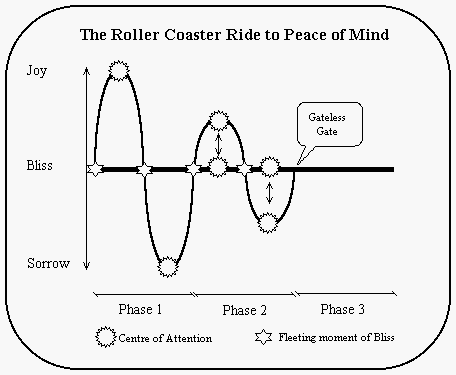
Ten years ago, before there was the monkey mind, there was the hobo mind riding thought trains loaded with emotional baggage. There was the roller coaster ride to peace of mind in three phases as shown in the diagram. 

For the details, check out my old web site - “Let it begin with me” http://www.srds.co.uk/begin/coaster.htm


Tuesday, 20 October 2015

hurray for happiness

These days progress and development are measured in terms of Gross National Product (GNP). But, when this increases, the level of happiness stays the same. Note that people in extreme poverty get happier as they get richer but only up to the level where basic needs are met. Wealth above that level does not bring more happiness. This is known as the Happiness Paradox. Many hardnosed books have been written on the topic in the last 20 years. Of these I have read and greatly enjoyed:

  • Abraham Maslow (1962) “Towards a psychology of being”
  • Mihaly Csikszentmihalyi (1992, 2002) “Flow - the classic work on how to achieve happiness”.
  • Martin Seligman (2001) Flourish – a new understanding of happiness and well-being – and how to achieve them”.
  • Jonathan Haidt (2006) “The Happiness Hypothesis – putting ancient wisdom and philosophy to the test of modern science”.
  • Daniel Kahneman (2011) “Thinking, Fast and Slow”.
  • Richard Layard (2005, 2011) “Happiness – Lessons from a new science”.
  • Leo Bormans (Ed) (2012) “The World Book of Happiness”.
  • Thaler, Richard H; Sunstein, Cass R (2012). Nudge: Improving Decisions About Health, Wealth and Happiness”.

Maslow identified a hierarchy of needs ranging from the basics of food, clothing and shelter, through belongingness and security, and onwards to peak experiences and self actualisation.

Seligman noted that traditional psychology aimed to help its clients move from subnormal to normal. He thus invented positive psychology which aims to help its clients move from normal to supernormal. He wrote an influential book about how to flourish and promote well being. It is a multidimensional process that is best approached on a multidisciplinary basis

The feeling of happiness has its biochemical and electrical correlates. Large gaggles of Neurologists are working on the details. The good news is neuroplasticity – by taking thought we can change our brains.

Human beings are social animals. We evolved to belong to a family, group, nation state, planet. Happiness is other people – at work, rest and play. Existing circumstances might not be all that good and there might be need for changes; cognitive behavioural therapy (CBT) now has oodles of tricks up its sleeves that can help out.

But we should not bite off more than we can chew. The serenity prayer offers a rule of thumb:

O God, give us the serenity to accept what cannot be changed,
The courage to change what can be changed,
and the wisdom to know the one from the other

Note for the hardnosed: the poetic notion of “O God, give us ...” suggests an anthropomorphic and metaphorical view of agency. A less poetic rendering of the notion would be, “May the unconscious churn in my mindbrain, with support from CBT (and/or mindfulness meditation) (and/or psychotropic medication), generate ...”.

There are two types of changes - in mind (internal) and in material circumstances (external). The latter include socio-cultural aspects of politics and economics including religion and the environment. And they scale along a continuum ranging from self, through family, community, nation and globe.

There is now an emerging alternative to the simplistic GNP. It is called Gross National Happiness (GNH) and is the basis of national planning in Bhutan and Nepal. It is also a topic of increasingly serious academic concern. For example the New Economics Foundation (NEF) has been developing a Measure of Domestic Progress (MDP).

Richard Layard's 2011 book (see above) covers most of the issues and was part inspiration for the website www.actionforhappiness.org which contains a lot of useful materials.

My subjective take on the topic is that happiness is a means to the end of achieving peace of mind which manifests as unattachment and serenity. A more holistic,intellectual and multidisciplinary approach will help with this but the real engine is direct experience of being non-egoic and mindful - of flowing and flourishing

Hurry for happiness.

Sunday, 18 October 2015

Training your monkey mind

Before mental training a person is likely to be asleep to, and unaware of, what goes on in their monkey mind. After mental training a person is calmly awake to and aware of what goes on.

Everyone has a monkey mind. Evolution made it that way. Its function is to monitor and react to the continuous flow of inputs from the sense organs. The goal in real time is to rate the inputs as good, neutral or bad. When snakes and lions were about the rating had to be done not philosophically but fast; and, if that involved using biased intuitions and rough rules of thumb, then so be it. For at least 100,000 years, as individuals, families, groups and cultures, we survived and prospered on diets of exotic myths and magic.

When a person's bias box is well stocked their mood can be peaceful. And old people can be respected because they have seen it all before. So - if it aint broke don't fix it? The rules and regulations of the conservative status quo will create the winning herd mentality. Let it be?

No! - physical and cultural environments change and myths and magic lose their relevance. Cognitive dissonance motivates radical revolution. Paradigms shift; and creative people inspire new rounds of myth and magic.

There are those who reckon that science is nothing but the latest round of myth and magic and there are those who reckon that it is a uniquely more insightful, evidence-based and rationally controlled process. The issue can be best discussed by people that have undergone two types of mental training aimed at taming the monkey mind – scientific method and mindfulness meditation.

Personal note: I learnt and taught about science and its methods for more than 10 years and I have practised mindfulness on and off for more than 40 years. I am now retired. But I maintain a blog that records my subjective impressions of what my monkey mind gets up to when exposed to recent thinking about changing minds.

It is never too late to train your monkey mind.

Friday, 16 October 2015

The ever active unconscious

The title says it all. The mindbrain is like the heart. They are both evolutionary products that serve as organs with particular, non stop functions. The heart beats and keeps the blood circulating. The mindbrain thinks, feels and has moods, and causes reactions to the external and internal stimuli that activate the sensory organs (eyes, ears etc).

Why bother? A simple question. But, in trying to answer, the story line gets complicated because we use language to ask and answer the question.

Language began to evolve about 100,000 years ago. It made sophisticated thinking possible and it passed through the generations. Man became the toolmaker and cultural evolution quickly moved people from foraging to settled agriculture; from the stone age through the bronze and iron ages; and from villages to cities and to the creation of empires with elaborate divisions of labour.

Language evolved. It's underlying structure involved sentences with subject, verb and object. And there was a tendency to see patterns and agents (ref Shermer) that gave rise to an abundance of myths and magic.

Truth is culturally relative. Different cultures have different truths which people die defending. But absolute 'truth' is not the issue. From the evolutionary point of view what matters is that the pattern of thinking in group A is implanted in more minds in the next generations than the patterns of group B. Natural selection with survival of the fittest.

Scientific thinking at its best does not deal with truth but rather with best working hypotheses. These are evidence based and groups of them hang together as a world view or paradigm. Once enough countervailing evidence accumulates the paradigm shifts.

The recent accumulating evidence in the fields of neurology, evolutionary psychology, behavioural economics and mindfulness meditation suggest that a paradigm shift is happening in our understanding of the structure and functions of the human mindbrain.

Carl Sagan noted that we are animated and dynamic stardust. That which was once inanimate and unconscious evolved as living and conscious beings.

Some of these beings developed the illusion of themselves as self conscious and invented cultural forms that reinforced the illusion and justified dying for the cause (aka resources).

A marginal few sat in mindfulness and overcame the limitations of language. They thus became awake to and aware of the illusory nature of views generally and of an abiding self. Lao Tzu spoke for the mystical community when he noted that “the reality that can be described is not the real reality”. There is an ineffable Oneness in the unconscious which predates language.

In retirement 'I' practice stillness and mindfulness so that a blissful, non-egoic state of flow captures attention. In the flow state the not-I lets the unconscious produce doodles and stories. 'It' is ever active and very rarely fails to deliver 'stuff'.

Thursday, 15 October 2015

About time

I am falling short of the aspiration to produce a story every two days. This is because ICT glitches have captured attention. I could write about the glitches but that would be nerdy and boring.

My preference is to witness and subjectively write about interesting insights from the unconscious. Some recent ones include:

A feeling of anxiety, fear and anger when I am faced with an ICT glitch. From my writer's point of view the technology and its tools should be invisible means to an end. I have no desire to stick my head into the workings of the tools; that is the job of nerds and geeks who generate the idiot-simple, user-friendly packages. There is division of labour and, from my point of view, a suspension of disbelief in coding magicians.

The lack of fine motor control of my fingers remains a problem for writing, typing and using the mouse. Handwriting is very small and often illegible. I have to type it while it is still fresh in my brain. The problem using the keyboard and mouse is that my fingers freeze and twitch and this causes typos. Luckily I graciously accept the condition and word process with equanimity.

My submissions to the Portsoy Past and Present columns in the local newspaper are edited stories from Findlay's research notes. My bits are about the past. Paulina and Colin do the present. But when does the present end and the past begin? There are different ways to look at this. My present thoughts and feelings move to the past when the next present ones appear. The time scale is from a fraction of a second to several minutes. OR – “give me the child till he is five and I will give you the man” – or at least a unit of stuff upon which to allow confirmation bias. OR time and thus the past began with the big bang 13.8 billion years ago.

And here ends a wandering story – about time!

Monday, 5 October 2015

Missing Targets


There are too many cute bits to play with in computers and the internet. They easily grab my attention and send it wandering. SO I could make a to-do-list, write it down, and stick to it. Focus.

The problem is that when I have a target it can feel bad to miss it. Alternatively – when there is no target it cannot be missed - and new ideas often turn up anyway. “If you don't know where you are going any road will take you there”.

Evolution works like that. It(?) has no forward plan and there is no planner. Stuff happens and some stuff survives better than other stuff. Survival of the fittest results because of natural selection.

These days there is scary talk about genetic modification (GM). But the principle is as old as agriculture. Farmers have been selecting particular types of plants and animals for thousands of years – and think of the varieties of potatoes, maize and rice, and of dogs, horses and pigeons that now exist.

And, as with plants and animals, so with ideas and cultures. Endless stories have been told since the advent of language about 100,000 years ago. Most of them quickly faded away while a few have been longer lasting.

Among the longer lasting stories are those that grew in the European renaissance and enlightenment. They gradually gave us the scientific worldview and method which have replaced the myth and magic of times past with the best working hypotheses given the evidence presently available.

I have just finished reading Steven Johnson (2010) Where good ideas come from - a natural history of innovation. He reckons that these days the majority of good ideas come from non-market oriented, multidisciplinary networks where individuals operate in flow. I have known such work eg developing a social science curriculum in Belize, and popularising policy documents in Tanzania.

Evolution doesn't' rule OK. nor does it make plans and to-do-lists.
sitting quietly doing nothing
Spring comes
and the grass grows by itself


Friday, 2 October 2015

Kinds of Kindness

In the new UK politics there is talk of kindness. It is not a well defined concept. In this short article I begin to map its many meanings.

At one end of the continuum is 'kind' and at the other end is 'cruel'. The motivation to act one way or the other is rooted in your nature, nurture or in chance. The kind/cruel reaction lies on an expanding horizon from 'me', through 'us' and 'them' to 'it'. The following table helps to think systematically about kinds of kind and cruel. Note that there are those who do kind and cruel things and there are those who have kindness and cruelty thrust upon them.

Some generalisations:


  • There is a tendency towards kindness when dealing with me and us.
  • There is a tendency towards cruelty when dealing with them.
  • Parenting is tough eg the terrible twos; adolescence
  • Mechanised agriculture is cruel to the environment.
  • Trans National Corporations exploit their workers and pollute the environment.
  • Genocide has been and still is quite common.
  • War propaganda demonises the enemy.
  • Those who know only Me and Us are naïve and easily exploited.
  • The rich get richer and the poor get poorer.
  • Instituted religion tends to produce zealots and suicide bombers.
  • Power corrupts so there is need of checks and balances.
  • 'It' includes climate change.
  • Human nature includes a territorial imperative.
  • Man is a social animal - “No man is an island unto himself”

Padding out the continuum


Kind people are good Samaritans who do not look away from suffering. Cruel people treat 'them' as inhuman and therefore fair game for exploitation – poor working conditions; rape, pillage, and enslavement; torture, murder and genocide.

The present refugee situation in the EU offers many examples of kindness and cruelty. Some host nations have crowds of volunteers freely donating resources and offering to help with the logistics of processing such large numbers of people. For many of the people traffickers the refugees are just commodities that are bulk processed so as to generate maximum profit.

It would be 'nice' if more people were kind and less people were cruel. This is possible. Preceding a kind or cruel action is a kind or cruel thought or feeling. If people develop a mindfulness practice they will be aware of the arising of thoughts and feelings and they will be able to choose between kind and cruel.

Kind and cruel are mind states associated with chemical and electrical signals in the mindbrain. By taking thought the signals can be changed. 'What fires together wires together'. It is never too late to change your mind.

Tuesday, 29 September 2015

A blip giving it lip

Parental passion in the spring of 1948 gave rise to the fertilised egg that was to be me. Some kind of  unconscious driving force guided cell division and differentiation in the nine months leading to being born. Then there was enculturation where nurture put the final touches on what nature had to offer.

There have now been 66 years of taking in food and water, passing out pee and poop, and being involved with education (in six countries). Main features of my life have included:

  • Infancy, childhood and adolescence in small towns in the NE of Scotland
  • 14 years of schooling, four years of University (Zoology), one year of Teacher Training
  • Teaching – two years in Edinburgh, two years in Jamaica, three years in Zambia
  • University – masters degree (Agricultural Extension)
  • Retreat, and supply teaching
  • Teaching – four years in South Sudan (+ education advisory work)
  • University – masters degree (Education)
  • Retreat, and supply teaching
  • Education Advisor – four and a half years in Belize
  • Retreat
  • Education Advisor – three years in Lesotho
  • Retreat
  • Freelance consultant – short contracts in Tanzania, Scotland, and for the ILO in Geneva
  • Retreat and private study – five years and ongoing (With Parkinson's Disease)

During all of that the action/reflection cycle has been constantly spiralling upwards. Several times I lived and worked in a foreign country then took time out to consider how my life is spent. Teacher teach yourself. Keep the ends open. Expand the horizons.

My parents had parents who had parents and so on back through primates, mammals, reptiles and fish to the big bang 13.7 billion years ago. I can trace my roots back to my great-grandparents 150 years ago. I never married and have no children. A tiny blip of stupendous inconsequence.

There once was only mindless matter but consciousness evolved and is now, with humans, aware of itself – at least in theory. The emerging insights of Neurology and Evolutionary Psychology have yet to make it big in popular culture. These days I help the process along when  I read, think, feel and blog. Lifelong learning.

66 and going strong - a mindful life.

A blip giving it lip.

Monday, 28 September 2015

murderous machetes


In Bangladesh there is a hit list of secular and atheist bloggers. Several of them have been brutally hacked to death by the machete's of Islamic extremists. Opposing points of view. Death to the unbeliever. There seems to be an effective education system. The propaganda is changing minds. Are there lessons to be learned?

I don't know. When I taught science in the S Sudan I did not pay much attention to what went on in the Madrasas. My impression was that the curriculum was limited and there was a lot of rote learning. And there was some reading of Arabic so they could study the Koran by themselves. The Madrasas produced unthinking robots; the government schools, if they were well managed, produced thoughtful citizens for the globalising world (?)
The British blueprint for education was grafted on to the colonies. It served its purposes well and it has continued to do so after independence. It acts as a sieve which separates out those who are best suited to operate in government and corporate institutions.

Successful education results in changing minds. Schools operate on individuals five days a week for about twelve of their formative years. Other formative influences include parents, community, and the worlds of work, church and the media. These are the nurturing forces that pad out the mindbrain's natural hard wired frameworks.

There is no perfection. I have some idiosyncratic thoughts that I post on a blog. But in this cosy, corner of the cosmos this will not bring machete wielding extremists to my door – inshalla.

Thursday, 24 September 2015

Say it again

There is a lot of repetition of ideas in my stories. This is a good thing. When I try to introduce and encourage new thoughts, feelings and moods, it is useful to repeat them over and over. The neurologists, when considering neural plasticity, are fond of noting that what fires together wires together; this is another way of noting that the road is made by walking.

My goal is to find better ways to be human and to make the world a better place. I now feel that mindfulness can contribute but there is a lot of slippage. By accumulating, listing and repeating the key ideas the mindbrain is kept floating above the dark stuff. And practice makes perfect.

Just sit.

Say it again – the only constant thing is change; the only certainty is doubt.

Always alternatives

Some people say that there is no alternative to the way things now are. They thus defend the status quo. But those people are lacking in imagination and creativity. It is self evidently true that the only constant thing is change and that the rate of change is increasing.

For the vast majority of our ancestral time we were foraging communalists. Being speechless we were slow to develop new ways of thinking. But, about 100,000 year ago, language evolved and the creativity and entrepreneurship of human groups flourished by creating and choosing between alternatives.

Archaeology recognises three stone ages – palaeolithic, mesolithic and neolithic. Then there was the bronze and  iron ages where a wide range of metal tools increased agricultural productivity and allowed for increasingly sophisticated division of labour (eg them v us within and between groups).

Foraging communalism was the human way for most of our time on the planet. Then came the domestication of plants and animals and settled agriculture. Then it was villages, towns, city states, and empires And in these modern times we have transnational corporations (TNC), the United Nations, and a wide range of nation states interacting and giving rise to globalisation.

Different human groups have different world views and associated points of view. They have concocted a fascinating collection of myths and magic. But now, since the European Enlightenment, there has been a gradual shift to a science-based set of facts and logic which, at its best, reckons that it does not deal with 'truth' but rather with the best working hypotheses given the evidence presently available.

Politics and economics are soft social sciences rather than hard physical ones like physics and chemistry. The soft stuff is dramatically more subjective than the hard stuff. The soft crew tries to present itself as hard but this is illusion. So there is bluster and spin. For example:

The present (2015) status quo view is that the collapse of communism marked the end of history because it is now obvious (?) that fundamentalist, free-market, invisible-hand capitalism is the only 'reasonable' way of running a corporation, a country or the planet. The single bottom line is profit. And the rich get richer because they are worth it.

In the early 1970s those who touted such right-wing free market thinking were dismissed as nutters.  The status quo at the time was for that brand of socialism called social democracy which had the triple bottom line of environment, society, and economics sitting on the foundation of justice and caring for the vulnerable. At present, 45 years later, it is the left wing supporters who are viewed as dangerous nutters because they challenge the right wing line of theoretical thought.

The only constant thing is change. There are always alternatives!

Monday, 21 September 2015

doodle origins


'I' am growing more aware that there are many more thoughts, feelings and moods (TFM) in the unconscious parts of the mindbrain than there are in the conscious and self-conscious parts.

Fair enough, this is a subjective impression; but there is hard evidence in terms of a continuous stream of TFM passing through the attention centre.

The TFMs come from the unconscious, capture attention for a while, and then they are gone. Where do they go? Do they go back into the unconscious in a modified form or are they like flames when a fire goes out? … I have not figured that out yet.

There are 'Aha' moments when the answer to a question suddenly appears - eureka. And, at their best, musicians are in the groove, athletes are in the zone and poets take dictation from their muse. This is normally linked to a non-egoic (self-less) state of mind which is expansive, awe-some and creative. It is called flow.

My mindbrain seems hard wired to make sense of random noise (patternicity eg to see constellations in the night sky) and to reckon that every action has an agent (agenticity eg to believe that droughts are punishments from the Gods).

These days I get my jollies through leaving the unconscious agent to 'see' patterns. And the patterns
manifest as short stories (text) and doodles (graphics). My technique involves avoiding distraction and busy-ness so that the mindbrain becomes peaceful in the non-egoic way - and text and graphics emerge.

My blog is testament to unconscious activity – text and graphics. This blogpost exists to demonstrate that of which it 'speaks' graphically. A good picture is worth a thousand words. Do they say anything to you? They are divided into five main categories:

  • Faces single
  • Faces groups
  • Faces abstract
  • Abstract
  • Scenes


Thursday, 17 September 2015

Intending to attend


Attention has been got at by ICT these last few weeks. There has been an upgrading of the technology first to a Samsung 8 inch tablet running on Android and with a touch screen, then an Asus X555L laptop running on Windows 8 and without a touch screen. Also I have moved from MS Office to Open Office.

I find it difficult to hold focus on a given topic – there are so many attention grabbing options at the touch of a button (astonishing apps). And my organic short term memory is not effective these days. I therefore need to muster the discipline for figuring how to make things happen and then repeating the procedure until it sticks.

Most programmes have a built in help system and this sometimes includes tutorials on how to get started and how to use the more sophisticated options. Failing that you can search for them on Google or Youtube. The quality of these vary but I usually find something useful from keen nerds.

I feel an intention coming to attention. The idea is simple . Print out a to-do-list and set a kitchen timer to limit the amount of time you spend with this aspect of CPD. Here is a generic list for the basics of using a new programme.
  1. how to enter the programme
  2. how to create a new file (or open one that already exists)
  3. how to enter data (ref types – text, clips, links, audio, video, photo etc)
  4. how to save or export the file (ref types)
  5. how to exit the programme


Sunday, 13 September 2015

Passing feelings

I am falling behind with blogposts. This one is made up of extracts from a letter to a pal. I have cut out the bits that mention various pals by name. No gossip.

There are so many people in the world and so few that I know. But then what is meant by 'knowing'. It has to do with 'communication' linked to predictability. When someone thinks, speaks and acts in a foreseeable manner there is 'familiarity'. This can be comforting but it can also be mind-bendingly boring.

My mind is culturally conditioned and is thus to some extent parochial despite my having lived and worked in five countries. But there is neural plasticity and by taking mindful thought most aspects of the mind can be changed. Some aspects of the mindbrain are hardwired by nature and these are tougher to transform than the more flexible nurtured bits.

Words, sentences, and paragraphs. The ever-active mindbrain churns them out. An agenda can be imputed to the unconscious but 'I' am not in charge of it. The same pattern holds true for the doodles. 'I' have no advance plan. Just begin and then let the muse do her thing.

Patterns of thought, feeling and mood (TFM) about TFM have changed rapidly in the last 20 years. The key to the new understanding is to view the human brain as an organ which evolved to enable small groups of people to be effective hunters and gatherers. Neurological advances linked to evolutionary psychology provided a platform for consilience (multidisciplinary approaches).

Note that Rick Hanson pulls lots of stuff together and writes about it well http://www.rickhanson.net/mind/ ) And, off the top of my head, three of my inspirational fellow travellers are Jon Kabat Zinn, Jonathan Haidt, and Daniel Kahneman. They all write and speak well. Google them or search for them on my blog http://naesaebad.blogspot.co.uk/ .

I have been semi retired since 1988 and fully retired for more than five years. I love it.

In the old days I thought I was doing something useful when I was teaching science and biology. However, my expectations for the higher level work (government advisor) were ill founded as were those about social development. My quest was to find better ways to be human. This transcended the worldly stuff - and it is ongoing. I have retired from the institutions but not from life. Every day is fresh and new. I invariably find interesting stuff welling up from the unconscious and knowing that it is not 'real'.

“Kunst, vas is das?” While cruising the social networks I came across a talk by Alain de Botton “Art as Therapy” https://www.youtube.com/watch?v=qFnNgTSkHPM - “Art can be a source of help with our problems — our innermost problems — the problems of the soul.”

I now have well over 200 'doodles'. Works of art? They vary enormously in subject matter and have been described as 'scary'. Examples are available at the top of my most recent blogposts. (http://naesaebad.blogspot.co.uk/ ) They are produced by non-action. 'I' let them happen. The unconscious is given a free hand. The muse? What is it trying to communicate?