Saturday, 1 August 2015

The devil’s work

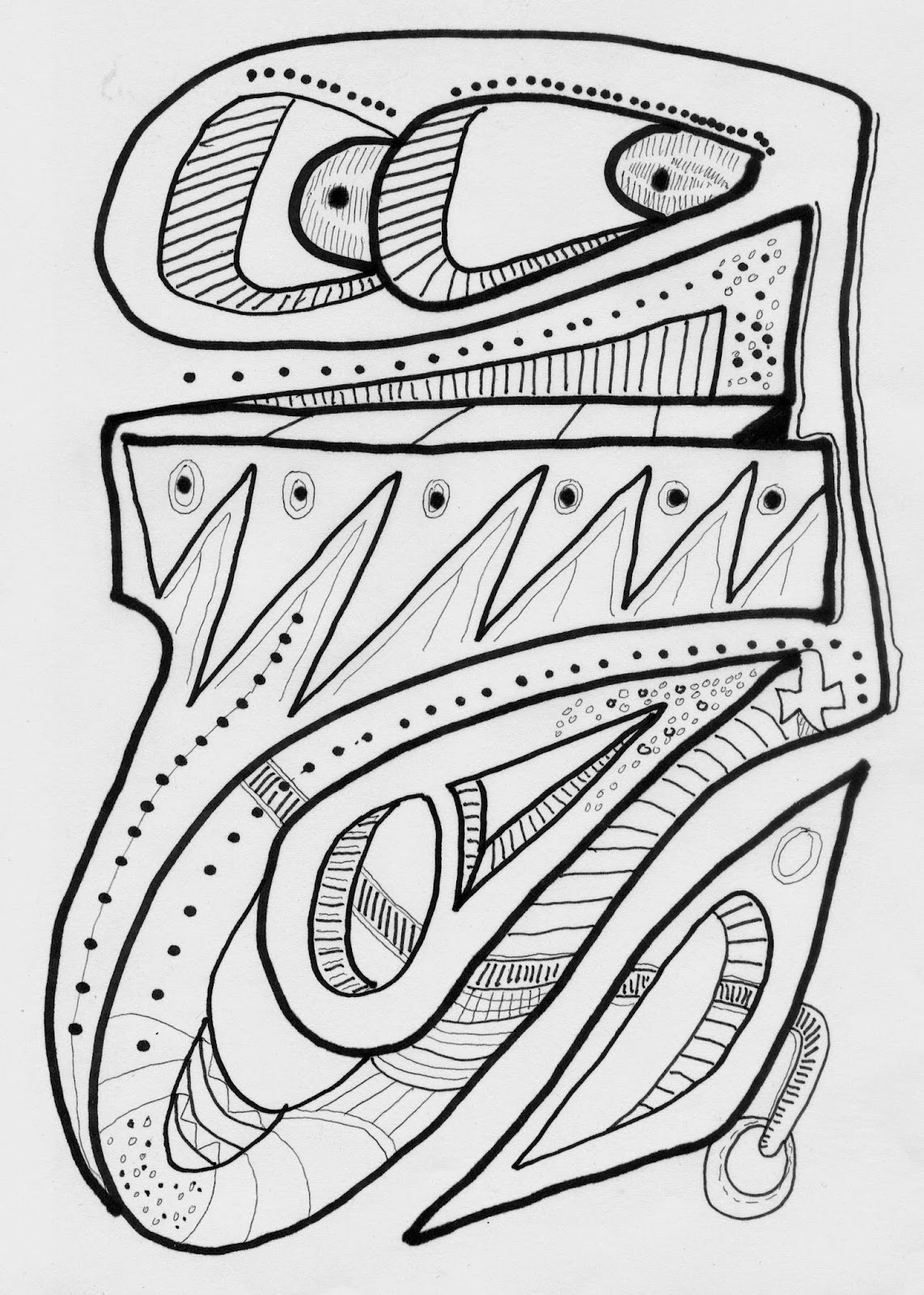
Earlier today there was no inspiration for an essay but I produced a couple of doodles and I painted the shed. Now I sense a wee story emerging – about passing thoughts, feelings and moods (TFM).

It is not possible to document all the TFM. It takes longer to write about one than it does to experience it. So how many is it worth trying to hold on to? At one extreme I could let them all go while at the other extreme, on a good day for concentration, I might manage to document 1%. But why might I bother? What would be the purpose?

I am now retired with a pension. So ‘work’ does not occupy mind space like it did for about 50 years.  There is still some house and garden work, and some unpaid voluntary work to attend to but I keep those at a minimum.

I live alone without wife or kids so ‘relationships’ do not occupy as much of my mind space as I assume they do of most other people.

‘Hobbies’ take up most of my time. Mainly reading, writing and doodling with a view to blogging. The main topics at the moment are big history, evolutionary psychology, neuroscience and mindfulness meditation. Sub topics include politics, power and policy under post capitalism

The mind wanders around TFM which are brought to my attention by the unconscious. These days the wanderings very rarely draw on my exotic past (lived and worked in six countries) or on my uncertain future (old age with Parkinson’s Disease).  Most of the time ‘I’ am in the present moment, in the non-egoic here and now.  Most topics last less than a minute while some hang around for more than an hour with a few that linger for several days (eg online shopping glitches).

A judgemental TFM has appeared. Some ‘shoulds’ from early childhood about the use of time. “When the good Lord made time he made plenty of it” – but he did not give it all to me. I should be doing something more useful with my time and energy. Avoid vacuous idleness because “the devil finds work for idle hands to do”.

Wednesday, 29 July 2015

online shopping glitch

An online shopping glitch has caught my attention and occupies my mind. I have just put the ball back into ‘their’ court. In theory I can therefore drop the issue while waiting for a reply. But dropping the issue is easier said than done.

Fortunately I can find relief by kicking the brain upstairs so as to get things in a larger perspective.  This involves imagining ‘doing a helicopter’ or taking a ‘cosmic zoom’.

Online shopping is a buying/selling process and therefore involves division of labour. It could be a barter situation (I will teach your kids if you will build my house) but in fact it is an exchange of goods for cash. It could be done face to face with known members of the community (my granny knew your granny) but in fact I am dealing with strangers or with their machines and databases. I am hard wired to be suspicious of ‘them’. (Beware of strangers.)

I do most of my online shopping through Amazon and I use Paypal to oversee the process of shifting cash from my bank account through my credit card and on to the seller who contracts a courier to collect and deliver the goods. Trust is an issue which merges with the ‘good name’ of the seller. This can be measured through customer feedback entered in a database.

Lots of stuff comes from Chinese factories on giant container ships which are filled and emptied in deep water ports which bristle with giant cranes. Large, articulated trucks then deliver the containers to the distribution hubs of the mega stores.

There is something pleasing about seeing the big picture. It frees the mindbrain from churning the intimate details. The ego-aware and parochial points of view have their uses, but it is good to get away from them now and again. This can be done by highlighting alternative and superior non-egoic themes.

SO – it worked. Before – there was the egoic and anxious mood related to the intimate details. After – there was a relaxed mood related to global economics and to a non-egoic frame of mind.

I am amazed and grateful that the process of buying and selling has evolved to its present level of sophistication. The glitch that initiated this essay is most unusual. There are few problems. The idea of an awesome set of miracles lingers on the margins of consciousness.

‘I’ have three university degrees and I taught science for 20 years but ‘I’ still occasionally lean towards the myths and magic of my ancestors. These go back 100,000 years to the time of foraging and before language. It is hard to calmly comprehend the speed and sophistication of evolution and ‘progress’ - especially over the last 3000 years which is no time at all by geological standards.

SO – a pernicious online shopping glitch in the here and now led to inspirational thoughts about the ‘magic’ of human evolution. Cool!

Tuesday, 28 July 2015

Default mode network

I am often ‘sitting quietly doing nothing’ other than noticing the breathing. It is then obvious that the unconscious is active because it inserts units of thought, feeling and mood (TFM) into the attention centre. The unconscious appears to have a mind and an agenda of its own although it is not always clear what these are.

When tightly focussed on a particular problem or activity I often experience an existential peacefulness due to being non-egoic and outwith time and space. There is ‘flow’ in the ‘zone’ regarding a topic. A form of non-self-consciousness is in control.

But, most often, there is the default monkey mind where the Zombie follows an autopilot programme put together in the unconscious.

For some time my image of the mindbrain has been of an iceberg - with consciousness as the small bit above the surface and with the unconscious as the huge mass beneath.

The feeling was that the conscious bit was reasonable and rational, and that it dealt well with the high level executive functions. The unconscious bit served to match up and evaluate incoming stimuli relative to memories. This set the feeling tone as positive, neutral or negative.

Note that this matches with Kahneman’s two systems of thought – fast, intuitive reactions v slow, rational responses.

From a survival point of view there would be need for fast reactions in life threatening emergencies and for slow responses in intellectually challenging situations. The fast reactions often happen before consciousness kicks in.

The above model assumes that the ongoing churn of the unconscious is foundational and that now and again it channels some stuff to consciousness for higher level processing.

HOWEVER - Recent research offers some fine tuning on the above model; this includes dividing the unconscious into networks which are made up of centres and associative areas.

The Default Mode Network (DMN) is different from other networks in that it is most active when the rest of the mindbrain is at ease, and least active when the rest is most active. The DMN consists of six areas of the cortex that are most active when no external tasks demand attention; and the DMN responds by going back to a high default activity level

Earlier thinking was that when we are not busy doing demanding things, our brain is “free”, or more passive; and we automatically think that we mainly use the brain to solve difficult tasks, or control goal-directed activities. However the new thinking is that the DMN occupies a substantial part of our cortex and spends every free moment on things other than being involved in external tasks.

There are three main DMN functions. It helps build our self perceptions; it builds a dynamic store of autobiographic episodic memories; and it integrates memories from our lives in a self-relevant way. This subjectively feels like mind wandering, daydreaming and reminiscence. These play a role in making a model of the world in which we live, and in predicting the future. They are also a source of creativity and of spontaneous thoughts about interesting problems.

The DMN includes five cooperating areas of the cortex. Two other networks in the association area are the attention and salience networks

The attention network controls how well we attend to specific tasks. Studies indicate that certain areas of the cortex have increased activity when we perform tasks with the attention focused in a specific direction or on specific aspects of the task.

These areas are active all the time, no matter what we are doing. But their activity increases, as does their impact, when we focus on distinct tasks. This feels like losing yourself in your task or work, and you just focus on what you are doing.

The salience network helps you to figure out how relevant a particular piece of information, or a thing you are looking at or thinking about, is to you.

To summarize:

  • the attention network makes it possible for us to relate directly to the world around us, i.e., here and now,
  • the default mode network makes it possible to relate to ourselves and our memories and previous experiences, i.e., the past and future.
  • the salience network makes us switch between the two others according to our needs.


This brings us closer to the perception we have of how we integrate information from the world around us with ourselves. We must be capable of relating to the external world, as well as our bodies, with some sort of self-image. Something could be important to you because you like it, or because you don’t like it and it is potentially dangerous. Those are critical decisions for survival.

New knowledge about the default mode network and the self-reflecting thoughts that it stimulates may help us to understand how we get by in our daily lives.

Ref: http://www.themeditationblog.com/the-brains-default-mode-network-what-does-it-mean-to-us/    Marcus Raichle interviewed by Svend Davanger on March 9, 2015

Friday, 24 July 2015

Productive diversions

There is anxiety. Part of my online shopping has been misdirected. I feel the need to be in the house when it eventually arrives – five litres of weedkiller and a tripod support for my Tablet.

So things are not going according to plan and thus - uncertainty – dis-ease - panic - an adrenalin rush. Unspecified dread about possible futures. An unhinged mood.

But - it is just mindbrain biochemistry. It need not command all the attention.

Therefore – diversion. “Stop the mind from wandering”.  Concentrate the mindbrain on something else. Read another chapter of the book about epigenetics. Doodle. Write this essay.

There could be a photo shoot in the garden. The photographer’s gaze is a powerful diversion.

Before the problem with my hands and voice I would sing while playing guitar or keyboard - and there were phases of writing tunes and songs. To be in a musical groove is a powerful diversion.

And there are the practical diversions of finding food, clothing and shelter; and of attending to domestic tasks in the house and low-maintenance garden. I aspire to tackle these with grace rather than with a grudge. I have no wife or kids. They presumably would be a powerful source of often unproductive diversions.

Aha – I am dosing in front of the screen and the mindbrain is wandering all over the place. ‘I’ cannot remember the details of the thoughts, feelings and moods (TFM) that occupied attention more than a few seconds ago. The mind has a mind of its own and is constantly churning out stuff for the robot on autopilot.

I wrote about this back in April/May when I gave names to thinking processes eg William the witness, Zorba the Zombie etc. The essays make the point that mind watching can be a productive diversion.

http://naesaebad.blogspot.co.uk/2015/04/head-voices.html

http://naesaebad.blogspot.co.uk/2015/04/a-writing-dialogue.html

http://naesaebad.blogspot.co.uk/2015/05/being-non-egoic.html

http://naesaebad.blogspot.co.uk/2015/05/churn-and-changing-mind.html

Wednesday, 22 July 2015

Diary Records

I have the option of looking up my daily diary records for what was happening on this day for each year going back to 1968.

But why might I bother?

The past is gone other than for a few memory items; the future is pure imagining; so all that I have is the present moment.

But how long is the present moment?

On the cosmic zoom the present moment ranges from subatomic nanoseconds through to historical, archaeological, paleontological, geological and astronomical scales.

Less ambitiously I could look up what was happening on this day in ten year lumps. That would be on the 20th July 2015, 2005, 1995, 1985, 1975, 1965.

Such an exercise would be possible because there are 37 ring pull folders  of diary entries covering 1968 to 2000 on the bookshelves; some are hand written, others are typed, and the more recent ones are word processed using  Locoscript, Wordperfect, and MSWord. There are digital copies from October 2003 till present. There is a gap from January 2001 till October 2003; I assume the records will be in the digital archives! But the motivation to dig them out is not high.

I am not much concerned about the detailed minutiae of my life. But I have considerable interest in the metacognitive big picture, the existential conundrum. Why am I here? What is the purpose of life? What lies beyond soap operas, stamp collecting and personalising my cave?

When I was younger, attention was captured by work. This involved getting paid for servicing someone else’s agenda. The main theme was education: teaching science and biology in the early stages and advising on leadership and management in the later stages. In five countries.

But I came to realise that ‘one size fits all’ educational development did more harm than good; it fails to adapt to the many different cultural contexts that exist. So I gave that up and became a free lance plain language editor of development literature. “Digested material gives power to the people.” But well edited bullshit is still bullshit. So I gave up freelancing and took up meditation.

And I have now been in retreat for more than ten years. Attention is focussed on rationally knowing and emotionally experiencing neurology, evolutionary psychology and mindfulness in the on-going present moment.  My diary records are therefore as much use as the Logoscript that once recorded them. The only constant thing is change so I follow the flow of thoughts, feelings and moods (TFM).

Notes:

  • The basic diary pages are splurges with little thought given to their structure. Should I wish to dig into my past the pages would provide reminders of topics that would otherwise be lost. But there is no feeling or mood to produce an autobiography.
  •  The Brande flows are a variation on the basic theme. The idea is to write whatever comes into my head for 20 minutes non-stop. It was flow of consciousness stuff. But it was usually uninspired and disappointing. Pass the ball to the unconscious and it does not bother to do anything with it.  I rarely use this technique these days because typing is now very slow and inaccurate because of loss of fine motor control in my fingers. (Parkinson’s Disease).
  • In Lesotho I edited more than 600 one-pagers which summarised work related ideas. When working with Hakikazi in Tanzania and with the ILO in Geneva there were many more giving instruction in the plain language process. Since retiring I have written well over a thousand one-pagers dealing mainly subjectively with the topics mentioned above. Most of them are used as blogposts which may help to promote and sustain the move towards humanity’s emerging ecological and non-violent world view.

Thursday, 16 July 2015

Obsessive diary

I used to be obsessive about the daily diary. For several years there was a new file every day. Sometimes it would be linked to Brande flows of consciousness against the clock, and to one-page essays.

But the pattern is changing. Over the last few weeks attention has been grabbed by social interactions, a Samsung tablet, and Windows Moviemaker - with gaps filled by doodling.

There is also the ongoing stream of thoughts, feelings and moods (TFM). There is an option on how much of this to record. It can be left to pass away (the 0% option) or every detail can be captured and analysed (the 100% option).

The 0% option supports the autopilot Zombie. My nature and nurture have re-created a world view in my mindbrain which is individual but socially delimited. The programming/education/enculturation includes a version of the Protestant work ethic where the devil finds work for idle hands to do and where, if there is no pain, there is no gain. Dreech workaholism and wage slavery.

The pure 100% option is aspirational but unachievable. If I spend all my time capturing and analysing every passing thought, feeling and mood there will be paralysis by analysis. So – there is need to prioritise and to focus attention to maintain mindful mentation.

For example, between the last paragraph and this one I (a) drove to the bank in Banff to deposit my two premium bond cheques, (b) shopped in Tesco, (c) began to open a parcel that arrived while I was away until I realised that the wrong thing had been sent and (d) interacted with Amazon about the parcel.

Monkey mind added various streams of detailed TFM related to the above topics but there was also many other fleeting bursts of TFM whose links to the main themes was not immediately obvious. The ephemeral stuff is created by the continuous churn in the unconscious which serves to monitor and assess the relevance of new material stimulating the sense organs.

Perhaps there was need for hyper-vigilance during the foraging days of the ancestors. You had to be awake to lethal dangers 24/7. Life is softer and safer in these modern times but the hyper-vigilance of the monkey mind lingers on. I try to witness and understand the process as much as the product.

There is still the churn of the monkey mind which directs the Zombie on the busy autopilot. And, increasingly, there is the delightful fact of non egoic non action where the unconscious gives rise to doodles and to these one-pagers.

It feels comfortable to note that the one-pager habit has come back. It helps to enliven the ancient Greek injunction to ‘know yourself’ and the Buddhist one to ‘work out your salvation with diligence’. The daily diary may be a spent force. Hey ho. The only constant thing is change.

Tuesday, 14 July 2015

more passing thoughts


I am missing the target of a story every two days. Various social interactions and new bits of ICT have commandeered attention. Life’s rich tapestry with mindbendingly detailed stitches has silenced the witness. There has been little time or inclination to notice what is being noticed and to think about the thinking, feeling and moods. I have been cruising on autopilot. Zombie.

This morning, however, there was a minding that the mind has a mind of its own. A search in my two blogs for ‘many passing thoughts’ created a list of eleven short articles between February 2008 and January 2015.

There is the option of producing a compilation that includes an annotated contents page. But, for the moment, I will blog the list and thus give some kind of ongoing reality to what would otherwise have been a passing thought.

Wednesday, 1 July 2015

Biological bohemian

Yesterday I said that “I aspire to a 400-600 word essay every two days and as many doodles as happen to arrive. There is still an appetite for doodles but the essay urge seems to have dried up for a while. This is a mild source of guilt but mindfulness wipes it out.” Today, on reflection, the idea is that it is not so much mindful-ness that wipes out the guilt as busy-ness.

The vagabond poet asked, “What is this life if, full of care, we have no time to stand and stare.” But there are more or less helpful ways to stand and stare.

According to Jon Kabat-Zinn , "mindfulness means paying attention in a particular way; on purpose, in the present moment, and non judgmentally." Dogen Zenji recommends that you “just sit” and thereby “drop off body and mind”. “Busy doing nothing”.

Recently there have been assorted bits of busy-ness which included watching the last of a three part documentary about “How to Be Bohemian with Victoria Coren Mitchell”

A bohemian is somebody, often a writer or an artist, who does not live according to the conventions of society but who lives and acts free of regard for conventional rules and practices. Other labels for such colourful characters would include outliers (outsiders), the vanguard, freelance philosophers. heterdox hippies, and eccentric nutters.

Some of my relatively mild Bohemian unconventions include:

  • If someone gives me cut flowers in a vase I leave them to wilt and rot so that I remember about the impermanence of all created things.
  • I spend a lot of time reading non fiction, doodling, and writing serious essays. This constitutes my ‘work’ and I see it as preferable to stamp collecting. I am justified by having tangible product.
  • I ‘believe’ in neurology and in evolutionary psychology.
  • I live alone and work from home. This cuts down on distractions such as idle chat, paying attention to what goes on in other heads, and generally servicing other people’s whims. “Go lonely as the rhinoceros”
  • I have been serially promiscuous.
  • I committed to zero population growth in the early 70s.
  • I lived and worked in five different tropical countries.
  • I leave washing up for several days.
  • I change the bed clothes every 6 to 8 weeks.
  • I run a very low maintenance garden.
  • I possess only one pair of shoes at a time.

This morning I woke at 6am, doodled and then dosed on a chair. There was a change of mood and of focus followed by a gathering of thoughts about evolutionary psychology. There was a minding about the project of letting the unconscious emanate cognitive and emotional outputs.

“Evolutionary psychology is a theoretical approach to psychology that attempts to explain useful mental and psychological traits—such as memory, perception, or language—as adaptations, i.e., as the functional products of natural selection.”

“Evolutionary psychology is founded on six core premises.

  • The brain is an information processing device, and it produces behaviour in response to external and internal inputs.
  • The brain's adaptive mechanisms were shaped by natural and sexual selection.
  • Different neural mechanisms are specialized for solving problems in humanity's evolutionary past.
  • The brain has evolved specialized neural mechanisms that were designed for solving problems that recurred over deep evolutionary time, giving modern humans stone-age minds.
  • Most contents and processes of the brain are unconscious; and most mental problems that seem easy to solve are actually extremely difficult problems that are solved unconsciously by complicated neural mechanisms.
  • Human psychology consists of many specialized mechanisms, each sensitive to different classes of information or inputs. These mechanisms combine to produce manifest behaviour.”

SO – there is the self image as a biological bohemian who is bothered that there must be better ways to be human.

  • But what constitutes ‘better’?
  • Peace of mind as an outcome of individual and group mindfulness.
  • No eternal verities and no zealous attachment to world views.
  • Give quality time to just sitting and to dropping off body and mind.
  • Be a witness to the stuff that appears in attention centres. Watch the thoughts, feelings and moods come and go. On purpose, in the present and non-judgementally.

There is the possibility of being normal and of running on autopilot and according to cultural conventions. Run of the mill Zombies.

There is the possibility of being abnormal and running on meta-cognitions which generate uncommon sense and counterintuitive ways of thinking, speaking, doing and being. Top level nutters.

I am easily swayed. When I hang out with Zombies I become one. When I retreat into my little house there is time and space for essays and doodles and to virtually hang out with exceptional thinkers and biological bohemians.

Howsabout yourself?

Where are you on a scale from 1 (zombie) to 10 (nutter).

Thursday, 11 June 2015

Doodles from nowhere

Doodling is a process that has a product. The physical tools are paper, pens and drawing board. The psychological tools include (a) the ability to use the pen and drawing board, (b) the mood and intention to do so, and, for the best quality work, (c) the ability to shut down the self conscious and thus to enter a non-egoic frame of mind where the unconscious is in charge.

While doodling there is very little forward planning. ‘I’ just sit until the hands move and marks are made on the page. This is what the Chinese call wu-wei or effortless action. At the moment this happens several times a day.

Each doodle has its own page and I note the date of its construction in the bottom right hand corner. Every now and then I scan the new collection and keep the files on a hard disc where they can be tagged and sorted. A while back I created a set of categories: abstract, scenes, and faces (single, groups, abstract). This needs a revisit.

I feel the agentic problem. There is product therefore there must be a producer who is presumably rational and purposive. But the presumption may be wrong – at least in part. In most cases the purpose and meaning of the doodle is not apparent.

Michael Shermer suggests that the human mindbrain is hard wired for patternicity and agenticity.  “Patternicity,” is the tendency to find meaningful patterns in meaningless noise. “Agenticity”: is the tendency to believe that the world is controlled by invisible intentional agents. Together patternicity and agenticity form the cognitive basis of shamanism, paganism, animism, polytheism, monotheism, and all modes of Old and New Age spiritualisms.

There is the notion that the unconscious is in a constant state of churn.  Mentation lego.  Gobbits of thoughts, feelings and moods (TFM) being shaken together in a sack. Some are fresh from the sense organs others are from memories of childhood through to what you had for breakfast this morning. A few are grabbed at what seems like random, made into a story by the unconscious, and dropped  into the attention centre  to see what the self-conscious can do with it.

The product is not the ‘truth’. Evolution is not concerned with such a thing. Pragmatism rules. If the story is convincing and ensures the survival of me and my group then we can accept it.

Through the years ‘I’ have engaged with several variations on this theme of giving the unconscious free rein

  • Art work in school – got a Higher
  • Doodles - ongoing
  • Many poems in the late teens and early 20s
  • Songs (music and lyrics) in two phases – 70s and 90s
  • Journal entries – since the late  60s
  • Short essays (one-pagers)
  • 75 tunes in the 90s
  • Brande flows (writing against the clock)
  • The seven word game (see below)
  • The seven word game is simple but awesome.  Try it for yourself and see.


SO - process and product:

  • The ongoing churn creates units of TFM (aka as ‘facts’)
  • The units are arranged to form a pattern (eg a World View or a group of points of view)
  • The pattern is championed by a real or  imaginary, intentional agent
  • The product is in essence a mind-made point of view but can be substantiated as spoken or written text, as music, or as doodles

SO - some thing from no thing?

  • Well over 100 doodles have been produced in the last few months
  • When I review them there is no strong message although there is a feeling that there should be
  • The abstract ones tantalise because of the details and the ambiguous perspective
  • The faces mesmerise even when they are basic emoticons – hard wiring in a social animal
  • At least one external viewer finds them scary
  • They do not encourage chat – they are pre-linguistic – like cave paintings?
  • The mood to produce  them remains frequent and strong
A physical doodle is created. It’s ‘cause’ is ‘activities’ in the mindbrain. The activities include the ongoing churn being fed by sensory inputs and by memories. Patternicity and agenticity are added to the mix. The purpose of the process is monitoring of the external environment to note whether the ‘thing’ is good, bad or indifferent. Relevant reactions and responses result. The fittest survive.

BUT there is a lot of noise in the system of churning. ‘Meaning’ need not always be created. Thus it seems we have doodles from nowhere.

Friday, 5 June 2015

Inviting writing to nurture culture

My blog has had 20,000 page views since January 2013. This averages 690 per month and 23 per day. The averages include low page views in the early stages. Last month for example there were 1240 page views which averaged 41 per day. It is interesting to know that my blog is being visited - but that is not what keeps me going.

I aspire to produce a blogpost every other day. The subject matter is mainly my reactions and responses to ideas about the structure and functions of the human mindbrain. This is a hot topic and there is an ongoing blending of eastern meditation with western neurology and evolutionary psychology.

However, on the downside, I am not officially connected to an institution and I do not have a large number of people to talk with and experiment on; and neither do I have a group of experts to provide peer reviews. But, on the upside, I have internet access to texts, audio and video from the leading experts in the relevant fields, and I have privileged, if subjective, access to my own mindbrain.

My mindbrain is shaped by nature, nurture and serendipity and most of its operations are confined to the unconscious. This becomes obvious when, during mindfulness, people feel that the mind has a mind of its own. Blaise Pascal (1623-1662) reckoned that “The heart has its reasons of which reason knows nothing”. The insight can be restated as, “the unconscious has its intentions of which the self conscious knows nothing”.

Sigmund Freud (1856-1939), while sitting in his armchair, reckoned that the unconscious was full of crude animal passions (notably sexual ones) that have to be held in check in civilised societies. However, recent research suggests a more positive view. It is the same nature, nurture and serendipity that shapes the unconscious and the self conscious parts of the mindbrain. So there is no need to demonise the unconscious; both parts have time-tested hard wiring designed to aid survival in small groups of stone age foragers in the African savannah. Some of this genetic programming might be out of sync with ‘modern’ patterns of living but cultural nurturing exists to shape them for the irrepressibly emergent new age.

Like most other people, especially western intellectuals after the European Enlightenment, I was earlier led to believe that the rational and egoic self-conscious should be promoted and the emotional and non-egoic unconscious should be suppressed. But, following research findings, there has been a dramatic turn around. I now view the mindbrain as a massive unconscious iceberg with a tiny, misty fragment of self-consciousness peaking above the vast ocean of reality.

Most of the important stuff happens in the unconscious. Many professional people now realise this and have learned how to exploit it. The trick is to shut down the self-conscious egoic chatter so as not to interfere. Athletes are in the zone, musicians are in the groove, and ordinary mortals operate in flow when they wash the dishes with numinous grace rather than with a grudge.

I am in two minds about my present method of being. I read, write and doodle non-egoicaly with a minimum of forward planning. This goes against my formal training - but that is the point. There is product in the form of stories and doodles that are generated effortlessly and in flow. It is as if something comes from nothing - but nothing comes from nothing. Thoughts, feelings and moods (TFM) originate in past times and are tweaked in the present by way of channelling the future. The evolving thought train never stops – not since the Big Bang.

There is need to radically change attitudes concerning ‘truth’ and ‘reality’ ie to change mindbrains. A thought train, which is in fact a TFM train, never in fact stops although many people, once they are culturally indoctrinated, are willing to die to maintain the status quo. We are all born free to be culturally nurtured but we are now at a stage of planetary evolution where more and more people are becoming mindful to the extent of appreciating that ‘reality’ is a mental construct which can be deconstructed.

Authors construct and deconstruct reality using spoken and written language. They come in assorted guises, notably, academics, bloggers, diarists, essayists, journalists, lyricists, novelists, playwrights, poets, scientists, speechwriters, and etc? I consider myself to be an essayist and blogger and I write for myself, for friends and colleagues, and for sub groups of the general public in various countries; there is a strong following in Ukraine and Russia.

There is a linguistic conundrum with the idea that ‘I’ write for my ‘self’. The idea is to park the ego and give my unconscious a free rein. There is an ongoing churn in the unconscious and every now and then a tit bit is directed to the conscious attention centre.

And that seems a good place to conclude with the title to this article - Inviting writing to nurture culture.

Monday, 1 June 2015

The need to know

The need to know – getting my existential jollies

A friend emailed to say that he will not be able to attend a pre-arranged meeting. No problem, I can reschedule my day. I don’t need to know what caused his change of plan.

I wrote the following sentence to send to the BT help desk - “When I am on the BT home page and click the email button the system goes to the login URL but then takes me back to the BT home page without logging in to the email.” But a reboot sorted the problem before I sent the email. I don’t need to know what went wrong.

I don’t need to know lots of things. I don’t bother with the nitty gritties. I get my jollies by wrapping my brain around counter intuitions and uncommon sense.

I suspect that there are different parts of the brain specialised in handling higher and lower degrees of conceptualising - possibly those parts of the pre-frontal cortex that deal with executive functions.

Most people do not philosophise about the grander aspects of their world view. They have been encultured to accept their natal version. They therefore inhabit a predictable, cultural universe which is chock a block with eternal verities:

  • The earth is flat.
  • Heavier than air machines cannot fly.
  • Atoms are indivisible.
  • A woman’s place is in the home.
  • We share ancestors with the great apes.
  • The Pope is infallible.
  • Kings and prime minister’s rule by divine right.
  • God is dead.
  • The war to end all wars.
  • Freemarket fundamentalism is the best guide to growing the economy.

My particular nature and nurture has been constantly reworking my world view with its list of verities. I was born into the UK class system as a subservient upper working class, church going, small town lad. But social mobility kicked in through being a boy soprano from seven, participating in archaeology digs from 14 and, studying for a university degree in Zoology from 18. I was a romantic in a tweed jacket who was convinced that the world could be a better place and that there must be better ways to be human. I committed to zero population growth and to experiencing different cultures. The need to know was at its peak.

By my early 20s my world view was informed by three aphorisms:

  • The only constant thing is change.
  • The only certainty is doubt.
  • So – follow the flow.

The western take on the aphorisms drew me to phenomenology, post-modernism and a vision of neurotic nihilists living in existential vacuums. All very depressing.

The eastern take on the aphorisms drew me to Taoism, Buddhism and Zen and to a vision of peaceful meditators living and working in non-egoic mindfulness. All very hopeful – at least in theory.

In the last twenty years or so there has been a blending of eastern and western world views and a rethink on the psychology of perception. The common root is an acknowledgement that thoughts, feelings and moods (TFM) are mind made mainly in the unconscious, and have no abiding reality – there is neural plasticity. The mind can change the shape and functioning of the brain which can change the mind. I feel the need to know more about this.

Evolution has been fine tuning the structure and functions of mindbrains since they first appeared due to cephalisation in ancient invertebrates. Bits of the ancestral mindbrains are still working in the lower regions of modern people including you and me. There are enduring structures and functions that first appeared in reptiles, mammals, primates, great apes and hominids. There are also new bits in human beings – notably the cortex and especially the pre-frontal cortex.

Since our stone age days of foraging these changes have allowed consciousness to be conscious of itself. And this ability has grown exponentially since language evolved, and it has enabled the growth of the eastern monastic tradition, western science and technology, and the hierarchical division of labour. I feel the need to know more about this.

Neurologists have been studying meditators. Their brains are different from ordinary folk. This is a result of thinking this way rather than that. They sit quietly and practice mindfulness. Amongst other things they bear witness to their monkey mind and, in so doing, calm it. Amongst other things the calmness allows a realisation of the ephemeral nature of their cultural points of view and this enables them to be un-attached from ‘truth’ and ‘reality’ and thus to radiate good humoured peace and encourage reconciliation. I feel the need to know more about this.

But who is the ‘I’ that ‘needs’ to ‘know’? And why those needs? And what does it mean to know? And which part of ‘me’ is asking those questions? One of my songs from the 70s has these lines:

“You’ll find plenty question masters
making quagmires of their brain –
The man said, “There is no answer”.
They said, “you are insane.”


I spent many years wallowing in the intellectual, truth-seeking quagmire. But mindfulness arose and with it the pre-linguistic realisation that “the reality which can be described is not the real reality”.  It was therefore arguably permissible, healthy and desirable to be open to change and doubt, to enthuse about counterintuitive uncommon sense, and to get my jollies by ignoring the nitty gritties and by calmly following the high level flow.

Thursday, 28 May 2015

Revolutionary ripples from a retreat

The internet is vast. It is easy to get lost and to fail to find world-changing wisdom in the oceans of facts.

BUT:

  • Search engines can return useful links (Ref: Google)
  • There are many online encyclopaedias (Ref: Wikipedia with its neutral point of view)
  • Using social networks you can follow and be followed by like minded souls from all parts of the planet. (Ref: Facebook and Twitter)
  • Like minded souls may well have blogs and websites from which you can take a feed. (Ref: Blogger and Wordpress)
  • The system learns your preferences and points you to interesting places. (Ref: ebay and Amazon)

SO …

It is relatively easy to focus on particular topics and to herd other people’s cows ie to analyse, systematise and memorise the conventional wisdom of the dominant group (COWDUNG).

It is also relatively easy to compare and contrast the ‘permissible’, alternative points of view that delimit and legitimise the hegemonic borders of what the Establishment considers to be ‘acceptable’ discourse.

It is also relatively easy to log in to the thoughts and feelings of the free thinkers who form the revolutionary vanguard. Often working in think tanks, these freelance philosophers exert countervailing and elegant power by liberating and deconstructing ideas that suffer elite capture.

Emancipated wage slave
When I was still a wage slave my duty and task was to rewrite thick, jargon laden, documents in plain language. So I was mainly reworking established wisdoms. My own thoughts and feelings were parked out of sight and rarely entered the attention centre.

Now I am retired and free to populate attention with whatever thoughts, feelings and moods (TFM) happen to emerge from the unconscious. I note a tendency to go back to Zoology which I studied from 1967 to 1971. My dissertation was in neurology and my extended essay was in primate social behaviour – small world.

My main areas of interest these days are intellectually in neurology, evolutionary psychology, big history, and mindfulness meditation, and, technically, in the art/craft of writing/blogging.

Linked TFM include:
  • Not being an accredited psychotherapist my first hand observations are limited to my own mindbrain
  • There are several subjective versions of ‘ego’ (I, me, mine, myself) (there is also William the witness – see earlier posts.)
  • Most of what the mindbrain does is confined to the unconscious
  • My main task is to become more aware of and awake to what goes on in the unconscious. This is done by paying attention to, and capturing what appears in, the attention centre. The ‘products’ are presently doodles and various forms of text.
  • ‘I’ am hard wired in the same way as everybody else but my enculturation is idiosyncratic as it includes many years working and living in various parts of the tropics. So in some ways what is ‘true’ about me is true of all humans, and in some ways my ‘I’ is unique.
  • ‘Present moment, wonderful moment.’ There is dis-ease (anxiety, stress, depression low self esteem and ‘what will people think?’) when I am mindful of the past or of the future. There is easy peace when non-egoic and in flow.
  • While being mindful of the present (eg by watching the breath) the switch can be flipped from dis-ease to easy peace.
  • The present moment these days typically lasts for only seconds although there can be switching. This is now the third day of writing this story. There has been a series of moments of thinking and typing which total about two or three hours. So how long did it take to write the story – three days or three hours?
  • The train of thought never stops for long on the never ending highway. Knowing this makes it possible to be unattached to a world view. Who lays the tracks?
  • The virtual Sangha is online with video, audio and text.
  • The analogue Sangha has about 30 regular members who meet once a week forty miles away. I have also attended several weekend retreats
  • My blog is a drip feed of pebbles in a pond where ripples run away – hopefully

There are many good thinkers and writers on all of my favourite themes. I am presently interacting with http://www.mindful.org/ whose board of advisors includes Jon Kabat-Zinn and Ritchie Davidson. And I am reading Watt, Tessa (2012-01-05). Introducing Mindfulness: A Practical Guide Icon Books. Kindle Edition.

Both sources are in plain language and are based on the experiences of large numbers of people. It is excellent stuff. I cannot compete as a textbook writer. I can, however, bear witness to what goes on in my head in terms of TFM. The target is a story every two days. The hope is that the stories might touch a raw nerve in some readers and that they are encouraged to continue their spiritual journey because of the revolutionary ripples from this idiosyncratic retreat.

Monday, 25 May 2015

Real moments

Reality changes one mindbrain at a time. But that mindbrain is influenced by others.

Changes in the environment lead to changes in the thinking, feeling and behavior of individuals, small groups, and even nation states. (Ref: demonization of Germans during WW2.)

‘Reality’ is changing its foundations from myth and magic to materialism and mindfulness: from pre-modern (traditional) to modern (scientific) to post-modern (consilient).

This train of thought is influenced by having just read the following sentences of Richard Restak:

“At this moment, while writing this sentence, I’m fully conscious of my purpose. Indeed, each of the sentences in this essay would be impossible if I didn’t remain conscious of my intention while writing them. Yet I’m not aware what precise form the sentences will take – that comes when I see them displayed on the screen. Thus my writing of this essay is a mix of the conscious and the unconscious.” [Restak, Richard M. (2012-10-25). The Big Questions: Mind (Kindle Locations 686-688). Quercus. Kindle Edition.]

It is the same for me but more so in that I am not fully conscious of my intention for writing this essay. There is a misty appreciation for the insights provided by scientists (Zoologists in particular eg J Z Young) about the evolution of brains in general, the embryological development of human brains, and the processes of enculturation in human groups. (Ref: ontogeny recapitulates phylogeny)

There are similarities between this spontaneous writing, and doodling. The unconscious streams and generates product - text and images respectively. ‘I’ am not aware of a forward plan for more than the next few seconds. Decisions about what appears next do not give the impression of being rationally controlled by the Executive functions in the pre-frontal cortex.

The main difference between the texts and the images is that the former have obvious meaning while the latter do not. I am assuming that both are rooted in the mindbrain churn where present sensations meet past memories and future actions are planned and sometimes implemented.

“If I have seen further it is because I stood on the shoulders of giants.” (Isaac Newton). I think in particular of those who summarised rational modes of action/reflection cycles eg

PIME
  • (Situation appraisal)  Planning
  • Implementation
  • Monitoring
  • Evaluation  (Situation appraisal)

Countervailing power
  • Gather information
  • Analyse information
  • Prioritize actions
  • Create an organisational mechanism
  • Periodically reflect on activities

Lesson planning
  • Aims
  • Objectives
  • Content and Method
  • Monitoring
  • Evaluation

In acquiring three university degrees I was encultured into believing that ‘I’ should ‘think’ objectively and generate evidence-based conclusions ie that I should use the scientific method. No problems. But, as I get older, ‘I’ ‘sense’ the potential of other ways of thinking and feeling.

There is the image of an iceberg with a vast amount of unconsciousness below the surface and a tiny bit of consciousness above it. ‘I’ am convinced (aka I believe) that there is much to be gained by focusing attention on attention. The belief has its roots in multidisciplinary science but it is informed by idiosyncratic subjectivity.

The serious stuff includes neurology, evolutionary psychology, Big History, and mindfulness meditation. The idiosyncratic stuff includes sitting, reading, writing and doodling. This results in alterations to my world view (Zeitgeist).

Reality changes one mindbrain at a time. (time = milliseconds to centuries)


Friday, 22 May 2015

perseverance


Two frogs fall into a bucket of milk and can’t jump out again. One gives up paddling and drowns; the second one refuses to do so and keeps paddling until the milk turns  into cream and it is able to get out.

Tuesday, 19 May 2015

My consilient Zeitgeist

The Zeitgeist Movement (TZM) has its critiques. I found them by Googling ‘tzm critique’ – duh!

TZM includes a lot of “wouldn’t it be nice if …” from a libertarian (anarchic) point of view. (Ref: https://www.youtube.com/watch?v=3SZT7MZop44)  But TZM assumes that economics is at the root of all things and thus underplays the psychosocial.

Having engaged with the topic there are now a lot of ideas swimming around in the attention centre. I will collect some
  • There is only the one thing which is everything (Note – the cosmic zoom puts things in perspective – we are star dust)
  • The one thing is the mega system which is made up of subsystems which are made up of subsystems. (Ref: systems theory)
  • Nothing stands alone, everything is connected (Note: Thich Nhat Hahn has the concept of Interbeing which links to deep ecology.)
  • Scientists operate using the best working hypotheses presently available. (Note: there is a tendency for older scientists to get stuck in outdated hypotheses. Science progresses one funeral at a time.)
  • Science is a product generated by a process. The product is (a) a theory based on evidence and (b) the theory being applied. The process is in part technical (eg controlled experiments etc) and in part psychosocial (the scientist operates in a cultural context with deep rooted values).
  • Modern ways of thinking are evolving away from the myths and magic that guided past ideas. They had their uses in times past but times have changed.
  • The only constant thing is change. The only certainty is doubt.
  • The thoughts about consilience (ref Sociobiology) from E O Wilson and from David Sloan Wilson are in the same ballpark
  • “In science and history, consilience (also convergence of evidence or concordance of evidence) refers to the principle that evidence from independent, unrelated sources can "converge" to strong conclusions. That is, when multiple sources of evidence are in agreement, the conclusion can be very strong even when none of the individual sources of evidence are very strong on their own. Most established scientific knowledge is supported by a convergence of evidence: if not, the evidence is comparatively weak, and there will not likely be a strong scientific consensus.” http://en.wikipedia.org/wiki/Consilience