Tuesday, 21 May 2013

Writers on drugs

In today’s on-line Guardian Alex Preston (writer) asks “Does Prozac help artists be creative? - More than 40 million people globally take an SSRI (serotonin-specific reuptake inhibitor) antidepressant, among them many writers and musicians. But do they hamper the creative process, extinguishing the spark that produces great art, or do they enhance artistic endeavour?

Preston chatted with a few artistically creative friends (I guess that they are mostly Guardian readers like myself) and found that most had been or were on Prozac and that they had mixed responses to it. 

I was on Fluoxytene (basically Prozac) to combat depression for about a year a couple of years ago. As I remember it the drug seemed to prevent the worst of the anxiety and panic attacks. But there was and still is the issue of ‘agency’.  What are the causes and conditions for the many thoughts and feelings that pass through my ever-active, attention centre? There are seven possibly interacting factors:

  1. I am now over 60 so old age will be involved. There is mild cognitive impairment.
  2. I practice mindfulness meditation both at home and with a Sangha in Findhorn (I completed a formal eight week course of MBSR (mindfulness based stress reduction)).
  3. I had several sessions with a psychotherapist in Buckie
  4. I was diagnosed with Parkinson’s Disease (PD) in October 2010. So some of the dopamine producing nerve cells in the substantia nigra are dead or dying.
  5. It took some time to figure the best type and levels of medication. I am presently on a mix of Madopar and Ropinerole and this is working well.
  6. Creativity (blogging) has recently been quite high but was hammered by a recent urinary infection with associated antibiotics that left me knackered.
  7. I live alone and work from home (except that I have retired from paid work). But I interact with various individuals and groups by way of keeping in touch with reality.

voice of the people
Preston’s article is based on a few anecdotes from a biased sample. Vox Populi. He admits this but it does not seem to worry him. He is a ‘writer’ rather than a scientist. What matters is that people attend to and buy what he writes.

As a journalist he has to produce material that is acceptable to editors and that follows the style guide for particular publications. (At the end of the article he plugs a couple of books that he has written.)

During 1998/99 I was involved with a home study course in ‘Article Writing and Freelance Journalism.’  My tutor was a crusty old newspaperman who was amazed to come across someone over 50 who still had ideals and an urge to make the world a better place. He was very pragmatic.

The bottom line was getting paid by an editor. Product has to meet the market. Therefore (a) research what the market needs and wants, (b) get the go ahead from an editor to expand a brief, and (c) only then get involved with the writing. Those who write first and then go looking for a buyer are likely to be artists starving in attics.

Journalists are word smiths, often cynical. Many take drugs, especially alcohol.

Writer’s are more than word smiths. The content of their stories are meaningful to them. Most novelists fall into that category. Many freelance intellectuals are also in that group  – people on my present bookshelf who might be included are Sam Harris, Michael Schermer, Ken Wilber and the late Christopher Hitchens. Most had a formal training in academic work when young but broke away from the institutions and became highly energetic independent intellectuals.

In 1998, after three years in Lesotho, I broke away from an institution (the UK Department or International Development (DFID)) with it’s long contracts. I became a plain language writer/ editor and worked for a range of employers on many one-off documents. I like to think that they were of high quality - there were many one-page spin-offs.

But there was a price to pay. I burned out – twice! The first time was when working on a tutor book with a friend in Geneva. I recovered from this and worked on several other books before burning out for a second time. It was then that I was diagnosed with PD and gave up paid work.

Priorities changed after the second burn out. Work on ‘development’ stopped and I concentrated on understanding and writing about my experience of mindfulness practice in the light of new thinking about neuroscience and evolutionary psychology.

And that is where I am today: an aging, mindful, meditator and freelance researcher, who is also a ‘writer’ (blogger) on drugs and with incurable brain rot. Most of the time this is pretty cool.

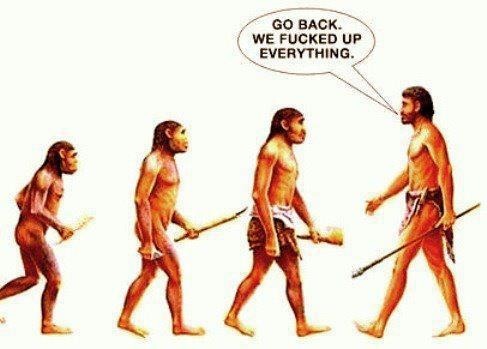

Saturday, 18 May 2013

Evolutionary Psychology Naturally!

The brain and its associated mind are in constant flux. This is right and normal. They are hardwired to this end. Their ‘purpose’ is to gather info about the external environment (as far as this can be known given the limitations of the human sense organs) and to relate this to past experiences. Those who learn from experience survive, those who do not learn do not survive.

There are different kinds of learning. The most ancient is by imitation – girls hang around with their mothers and other female relations – boys hang around with their fathers and other in-group males.

Most human groups have initiation rites of passage. These can be emotional and severe. The idea is to quickly and thoroughly change the individual’s view about purpose. “When I grew up I put away childish things.”


When language (and song/chant) was very young it is easy to imagine ceremonies based around the cave paintings in their splendid seclusion. There would appear to have been cultural patterns and agents giving ‘meaning’ to what might otherwise be a very scary place. Much to know.


As language matured there would have been more rational states of mind perhaps relating to detailed points about the practicalities of hunting and gathering. And as the evening fire turned to ashes thought may have turned to putting the world to rights through dealing with abstract concepts such as truth, beauty, justice, compassion; and with anger, greed, jealousy, status etc. Those groups that communicated more effectively had better survival value.

From the point of view of evolutionary psychology most of these thoughts, moods and emotions will have evolved to be as they are today for a given, adaptive, purpose.  Evolution would have been running at the level of individuals and groups. First stone axes and then, a few minutes later, manned spaceflights to the moon and robots on the surface of Mars.

So what is the point of telling this story? The idea is to breathe air into the thought pattern labeled as ‘evolutionary psychology’. Take it for granted. Treat it as ordinary. The story’s made by talking.

Back in 1997, Leda Cosmides & John Tooby, in “Evolutionary Psychology: A Primer” noted that the older and empiricist Standard Social Science Model (SSSM) had been replaced. These days, “All normal human minds reliably develop a standard collection of reasoning and regulatory circuits that are functionally specialized and, frequently, domain-specific. These circuits

  • organize the way we interpret our experiences,
  • inject certain recurrent concepts and motivations into our mental life, and
  • provide universal frames of meaning that allow us to understand the actions and intentions of others.
Beneath the level of surface variability, all humans share certain views and assumptions about the nature of the world and human action by virtue of these human universal reasoning circuits.”


In short, although great learners, human beings are hard-wired in many ways. Our genes express themselves as ‘instincts’ and there are many specific examples of these, especially relating to social relations.

Thursday, 16 May 2013

bruce hood


Bruce Hood

Bruce Hood is an experimental psychologist who specialises in developmental cognitive neuroscience. His research interests include the cognitive processes behind adult magical thinking. He is well known for his ideas that humans are not rational creatures and this innate irrationality leads to religion and superstition.

 
Bruce Hood - "The Self Illusion: How Your Brain Creates You" - TAM 2012  

His research interests include:

  • ·         the origins of supernatural beliefs,
  • ·         intuitive theory formation,
  • ·         object representation,
  • ·         spatial cognition,
  • ·         inhibitory control and
  • ·         general cognitive development


He has written two books for the general public:
“SuperSense” (HarperOne, 2009) about the natural origins of supernatural beliefs which has been published in 12 countries, and

“The Self Illusion” (Constable & Robinson 2012) about the fallacy that we are coherent, integrated individuals but rather a constructed narrative largely influenced by those around us.

retirement planning


On top of Parkinson’s Disease and its dopamine increasing medications I am presently got at by a urinary infection and its antibiotics. The infection has been lingering for a week and has induced lethargy and a reduction in posts to this blog. 

I have just returned from the nurse who took blood samples to send for testing. She has exams tomorrow which are stressing her. She is due for retirement soon. She is looking forward to having the pressure levels cut back. There are thoughts about the University of the Third Age.

I have not engaged with formal education as part of my retirement plan. I don’t really have a retirement plan although there is a strong intention to record my progress with mindfulness. The problem with that is the Parkinson’s. The disease and its medications make my experiences abnormal and thus of limited value to other people. But there are grey areas. The PD may be more or less readily felt in some areas than in others. It can, for example, be discounted when I am dealing with neuroscience and evolutionary psychology.

Sunday, 12 May 2013

Why would one talk posh in Buckie?


This morning I was inspired by a Herald article“Linguists ask: Why would one talk posh in Buckie?”

In my linguistic history I spent my first 12 years in Buckie – toonie rather than fisher or fairmer – then 6 years in Portsoy. Then another 5 years at University in Aberdeen.

Then, in 1972, I failed an interview for VSO because the interviewer, who came up from England and had a posh accent, could not understand me and therefore reckoned that I would give foreigners a tough time. I can no longer remember the details but I reckon the bloke’s excessive poshness must have made me turn up my Doric class war button. That was not a sensible thing to have done. But it worked out well in the end. 

I past another interview and went to teach in Jamaica where the kids had fun imitating my Scottish accent. But this was my semi-posh, International Scottish voice rather than the Doric. I was well aware of the two forms and when they might be used. Patois is the Jamaican Doric. It has deep and shallow extremes with political and social implications.

I subsequently worked in 5 countries where the official language was English – but there were many other first languages (eg 92 languages in the South Sudan). The kids were nearly all multilingual – often in languages which were very different. This made my encounters with the Doric seem pretty small beer.

I was in the S Sudan helping to set up a Model Day Secondary School. Part of this process was to think of all form one teachers as teachers of English as a Foreign Language. This allowed a maximum number of kids to become competent in English despite the fact that the form one teachers came for a wide range of linguistic backgrounds themselves. 

Later in my career the focus shifted from what was being taught (general science and biology aimed at children) to the process of communication at the national level through the use of ‘plain language’ to influence poverty reduction strategy.

Bit I hivna bed awa. In atween the foreign jobbies a’v taen some time oot tae contemplate the infinite fae Portsoy. When the al fokes were still aroon we’d blether in the Doric. Bit these days the groups that I deal wi hae ootsiders among them so we dinna ging far intae the Doric.

I did my bit tae keep it alive by writing a Doric version o the Boat Festival’s Souvenir Programme’s welcome page for a few years. Bit that wiz jist a token gesture. 

I maybe suffer a bit of ‘colonial lag’ because of my time in ithir pairts. But it seems like a cruel twist o fate that I have not done more to promote my ain language and culture. Perhaps self deprecation is part of the ethos. Doric foke dinna hae existential crisis or class wars? Fitivir. Doric’s on the wye oot. “Why would one talk Doric in Portsoy”.

Monday, 6 May 2013

Goodly repetition

Thich Nhat Hahn
There is repetition in these blog posts. There are many happy returns to the same old themes. This is not a problem. You need more than one nail to fit a horse shoe.

Thich Nhat Hahn has published more than 100 books, including more than 40 in English. I have read several of them. My favorite is ‘being peace’ but it is the same basic story in them all. What matters is not so much what is said as how it is said. The goal is not so much a heady intellectual understanding as a hearty emotional comprehension. Thay is responsible for the neologisms ‘inter-being’ and ‘engaged Buddhism’.

Jon Kabat Zinn created the Mindfulness Based Stress Reduction (MBSR) programme. At least three of my sangha are qualified to teach it and I have taken it. As an author Kabat Zinn’s books tend to be collections of short articles that elaborate on the theme of mindfulness. This makes easy bed time reading. He guided me to sleep for many months through two of his books – ‘Wherever You Go, There You Are: Mindfulness Meditation in Everyday Life’ and ‘Coming to Our Senses: Healing Ourselves and the World Through Mindfulness.’

In his work Kabat Zinn has removed most of the references to Buddhist vocabulary and imagery. But the underlying psychology of perception remains. He defines mindfulness as "a moment-to-moment, non-judgmental awareness”. Be still and know that the craving ego is illusion and thus be at peace.

In essence the process is simple and straightforward. It involves ridding your ‘self’ of unnecessary suffering and becoming enlightened, compassionate and a force for peace in the world. The underlying task involves changing the way that your mind thinks about and uses itself.
Jon Kabat Zinn

It takes focused intention and effort to change your mind. This is because the old habits have dug themselves into deep channels. It takes a lot of time and effort to fill in the old channels and to dig new ones. But it is possible. In a way you are doing it all the time – you are no longer the infant, child and adolescent that you once were.

Buddhism speaks of the six perfections. They suggest that those who are generous, moral and patient find it easier to make the effort needed for meditation and to be wise.’

So it is not a problem that these blog posts are repetitive so long as they capture imaginations and trigger wholesome changes of mind.

Mony a mickle

There could be a story today. It could be about not having produced a story for several days. I am easily distracted. I have not been practicing. So what have I been doing?

I have been engaging with other people’s agendas. Three photoshoots, two community group exhibitions, one wedding reception, and no weekly meeting with the sangha. That is not everything that has happened in the three days since I last wrote - but it gives a flavor.

The larger point is that social ‘stuff’ sucks me into roadside attractions and I lose sight of the spiritual path. I can thus appreciate why people hie themselves to monasteries and nunneries. If the goal is to turn the mind around then there is need to stay focused. It is a simple timetabling issue. You cannot afford to spend too much time with distractions. But how much time is too much?

There are options ranging from a strict and ferocious monastic closeting at one end to a more casual, laisse faire, on-demand system at the other end. Circumstances dictate that most people are at the casual end of the spectrum.

But there is a middle way. Mindfulness is the key - with the image of many types of bell calling you back to your true home. Be aware of events - brushing your teeth, evacuating your bladder, washing the dishes. Pause mindfully before - logging into your email, picking up the phone, starting the car. Ten seconds of awareness is better than none at all.

As well as continuous cushion time there are sporadic moments of everyday Zen. And every moment counts. As they say in the Doric, ‘Mony a mickle maks a muckle’.

Friday, 3 May 2013

Wheel and deal

this is not a blank slate
There are no blank slates. All ‘things’, real and imagined, have their causes and conditions.

It is said that ‘nothing comes from nothing’ and this implies that ‘everything comes from something’. Where did your ‘me’ come from?

Ultimately everything comes from the big bang. This initiated cosmic evolution such that planet earth came into being. Then there was biological evolution such that living things came into being. Then there was cultural evolution such that self conscious, large scale politics and engineering came into being.

Then a sperm and egg got together and you were created. The starting point was a single cell containing genes that had causes and conditions stretching back to ancestral times. The first cell divided many times to create a foetus that after nine months was expelled from the womb into a particular cultural and social environment. For seventy years ‘you’ then wheel, deal and maybe reproduce. Then ‘you’ die and your physical body rots and its chemicals return to the churn that is the vital force. If you were fit in an evolutionary sense you will have left more copies of your genes than other people in your group.

KEY SENTENCE: “For seventy years ‘you’ then wheel, deal and maybe reproduce.”

A life time of wheeling and dealing – are the details worth dying for?

Thursday, 2 May 2013

Decluttering by re-location

Maseru, Lesotho
About seventeen years ago I bought a high spec desktop computer to drive the recording studio that I had set up on a Lesotho hillside. Along the way I incorporated two outboard pieces of kit - an Iomega disc drive and a Backpack CD rewriter.

Unusually at the end of a contract, I took the clutter back to Scotland. This was about fifteen years ago when a friend’s son upgraded it and I set up another home studio to record my tunes and songs – see below for links.

Having recorded my songs I lost interest in the home studio and the kit lay unused while the world went usb and it became easy to record wav files along with midi in the same programme.

I set up the system this morning to transfer the work related files from the Iomega disc drive to a more up to date medium. But the system would not boot – the error message – “CMOS battery failed”. I looked up the error message on the internet. The problem is easily solved – replace the battery on the mother board (probably a CR2032 button battery). To be on the safe side I will take it to the computer experts next time I am in Banff.
Button battery

So today I became aware of clutter. When I upgrade my technology I should throw away the outdated versions even if they are in good working order. Also, when I finish home based writing projects, I should throw away the literature – at least the preliminary drafts.

The problem is that I have now been in one place for a long time. The earlier pattern was to work for several years in a foreign country and then to abruptly leave with a half empty suitcase. Decluttering by re-location. Very little was wasted of what I left behind. Plastic milk bottles were highly prized – especially if they still had a lid!

But I have no intention to move again. I will have to make a project out of the decluttering process – with objectives and measurable targets. How much is enough?