Sunday, 10 March 2013

spiritual sustainability

cafe chat
After a two and a half hour session of meditation with the Sangha I had coffee and chat with Jane - another biology teacher.

The main theme was the link between new science and the old dharma.

But I noticed that I was noticing shortcomings in the process of interacting almost as much as the subject matter.

Thinker be-aware

There was the normal problem of short term memory loss – especially for names and, in my case at least, for the details of concepts such as epigenetics and consilience. There was a spacious and nebulous ‘feel’ for the concepts but the ability to distil it into words was missing.

Another problem was that I often lost track of where story lines were going – especially Jane’s. I understood the individual points as they appeared but I forgot the earlier ones as the later ones arrived. This was perhaps a variation on the poor short term memory theme.

There was also the ‘intentionality’ problem. I do not give enough attention to what other people are saying - unless it is easy to position it on the map of my pre-existing viewpoints and world views. This might link to my encultured thought habit that there is a ‘truth’ out there and that there are paths leading towards and away from it. 

I quickly lose interest when I judge that the other person is on an away path. And this is in spite of the fact that, in rational up-front consciousness, ‘I’ no longer believe in stand alone, real truth. It would appear that (a) the old-fashioned thought habit still exists in the unconscious and (b) it can easily pop up in lazy brained moments. Thinker be-aware!
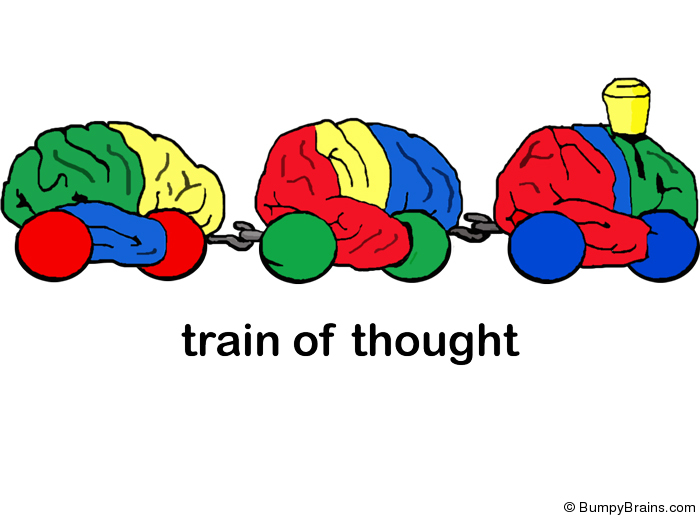
But this is not only a social interaction problem. My own thought trains sometimes stop short. Several points present themselves as if lined up in a row. But suddenly attention is withdrawn from the story line and there is a stupefied pause: I am struck dumb or at least made to stutter. 

But there is a workaround. I can write down the various individual and sequenced points. It is then a simple matter to re-view them and keep track of how they fit in the bigger picture. There can be ongoing additions and subtractions and fine tuning of the sequences. Much of the patterning of the utterance will be rooted in the ever active unconscious. Note that there is a strong whiff of an ‘intentional agency’ but it is hard to pin it on an ‘I’. 

Psychological (mind) stuff has physiological (brain) correlates. The ‘stop short’ phenomenon might be due to (a) a cessation of activity in the involved brain modules or (b) a break in the transmission from unconscious to conscious. These in their turn might be due to old age or, in my case, to the impact of Parkinson’s Disease and its medications on the amount and location of dopamine in my brain. The cause of the PD remains unknown. PD – why me now? Serendipity!

Listening and sharing

ATalkingStick
Previous to the chat in the café the meditation session had included a period for ‘sharing from the heart and deep listening’. The ‘talking stick’ went round the circle of sixteen participants most of whom took the opportunity to say a few words about their practice.

I cannot now remember in detail what was said but several people noted a feeling of having their minds read and of how comforting it was to realize that people who were apparently very different can have very similar experiences and stories.

The meditation session also included a dharma reading. A book by Jack Kornfield was passed round the circle and each person read a few paragraphs. In the café chat afterwards we noted that dharma stories from books or tapes are usually well thought through in advance. This in itself is not a bad thing but it creates the mode of shepherd and sheep, of expert and novice, of self and other. This again is not a bad thing in itself but (a) it does not go down too well with those who are not sheep, and (b) it affords an existential cop out for the sheep.

Most of the participants had experience of non Thay traditions. They reported finding the Thay way more democratic, and user friendly. The emphasis on everyday practice was particularly appreciated.

My early interactions were with the spiritual literature and more recently with audio and video presentations.  I attended various local weekend retreats in the last few years – FWBO and Northern Lights at Newbold House, and Mike Leutchford  and David Smith at Anam Cara.  I immersed myself in Zen and then in Vipassana before finding the Thay way.

The evolutionary emergence of mystics


Mystics are in every culture but always in very small numbers. They all point to the possibility of using the brain in a more enlightened way. They talk of liberation from the parochial and xenophobic worldviews that prevail in post hunting and gathering humanity. They talk of the enlightened mind state as our human birthright.

In terms of ancestors, the primates were around 75 million years ago, the great apes 15 million years ago, and early examples of the genus Homo 2.5 million years ago.

Somewhere around 200,000 to 50,000 years ago modern human culture started to evolve more rapidly. People were hunters and gatherers during this period but they used tools and early versions of language. This shift to behavioral modernity has been called a "Great Leap Forward", or the "Upper Palaeolithic Revolution". 

Like all sentient beings people were conscious at that time. The additional capacity for being self conscious presumably grew along with language. The mental construct that is the “illusory self” would have had its roots during this period and, given that it has survived and expanded, it must have had its uses. The majority of people conceived of their selfish ‘self’ as having an abiding reality – they did not see the illusion.

Karl Jaspers reckons that there was an Axial Age, a second leap forward, during the period from 800 to 200 BC. Similar revolutionary thinking appeared in Persia, India, China and the Occident and the charismatic mystics who were involved became the face of what are now the major world religions. 

A sequence begins to emerge:

conscious                                           no self - encultured robot
self –conscious                                   self and other (dualism)
conscious of consciousness                  no self only the Oneness

What might this be about from the point of view of evolutionary psychology? Survival of the fittest what? It seems reasonable to suppose that group or community selection is most relevant. The struggle for survival is between communities with more or less efficient and effective political and economic systems that are supported by language.

The vanguard is coming

Once an effective social system has evolved there is need to lock it down and preserve it. A mystical lunatic fringe of nutters is not therefore appreciated. “That man thinks too much, such men are dangerous.” But when things change, as they surely will, an elite fringe of creative sages is needed as a source of innovation and inspiration.

Lost in thought
The move from hunting and gathering towards settled agriculture, city states, empires and nation states was not an unmitigated success. The quantity of food produced by an individual farmer increased but the range of food stuffs decreased. Various forms of malnutrition became endemic. 

And it might be argued that there was a corresponding form of spiritual/ psychological malnutrition. The workers were encouraged to reify their selfish selves and thus to become wage slaves and capitalist consumers. The ruling elite used the media to hegemonise the cultural world view and to keep the peasants in ignorance.

And so the noble savage of old becomes the spiritually and psychologically malnourished serf. This is not so much wrong as maladaptive. It results in psychological and physical dust bowls.

What is required is a massive mind set campaigning for sustainable green. The time may be right for such a thing. There is deep rooted disaffection with the way things are. God is dead and people are existentially adrift. 

Mindfulness meditation is becoming popular in the West. For example Mindfulness Based Stress Reduction (MBSR) has gone mainstream with many thousands of people taking part in courses. There are eight sessions in a course and evaluations are typically very positive. 

There is an ever growing vanguard drawing on east/west synergies. Here are a couple of potential bumper stickers:

Spiritual support for sustainability
Mystical movement for a mindful modernity

Saturday, 9 March 2013

come by itself

Thich Nhat Hanh
"Do not just look for what you want to see, that would be futile. Do not look for anything, but allow the insight to have a chance to come by itself. That insight will help liberate you."

~ Thich Nhat Hanh

Friday, 8 March 2013

Ranting quick and slow


monkey mind
Everyone has bursts of mental proliferation (Papancha). Various metaphors are used to describe it. Monkey mind and cascade (waterfall) are two common ones. There is even the image of a demented monkey on amphetamines and with fleas.

The proliferations consist of thoughts with associated feelings, moods and emotions. Most of them emerge from the unconscious and they are beyond conscious control. It is as if the mind has a mind of its own and is prone to constructing stories based on more or less random causes and effects.

Many creative writers speak of a flow or stream of consciousness although it might be better to think of it as a flow or stream of unconsciousness. The mental stuff arises out of nowhere and it can be spoken about and written down.

Raging Torrent
We can extend the image of a flowing stream. Sometimes it is a watercourse or river in spate. It is a rushing, gushing, surging, flooding torrent. At other times it is a stagnant rivulet barely managing to ooze a trickle of dribbles.

The extremes are readily noticed by meditators. In terms of the five hindrances to mindfulness the gushing torrent links to ‘restlessness and anxiety’ and the stagnant rivulet to ‘sloth and torpor’.  

The extremes are also noticed by most creative writers. At times they experience flow where their ‘muses’ are an indefatigable source of ideas and at other times experience writer’s block due to their inspiration having dried up.

Writer's Block
I have no urge to write novels  but I have kept a journal for many years and more recently have published one-pagers on an assortment of self managed web sites and blogs. Productivity has varied enormously through time. 

Hard copies of my journal entries between 1965 and 1998 (33 years) take up 1.7m of shelf space. The rate of production nose dived when I was a workaholic contractor and soared while engaged in several long retreats between jobs. I stopped printing hard copies in 1998 and retired permanently from paid, worldly work in about 2010.

Since late 2002 my “Existential Soft Rock” blog http://dodclark.blogspot.co.uk/ , has received 504 posts and 27377 page views. This works out at about 50 posts per year (one per week) on average, with a range from 32 to 75 per year. 

These last few years have been fairly quiet in terms of one-pagers but this is changing. The more recent products are longer, and I think of them as midway rants - somewhere between gushing torrents and docile rivulets. And I am now more comfortable with letting the vital churn that is the unconscious do its thing. No gods, demons or magic muses – just a steady reworking of stardust spinning consciousness of unconsciousness at the edge of the milky way.

no-thing

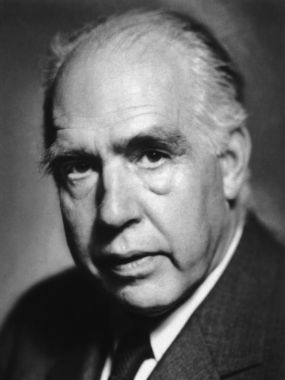
Niels Bohr
"Everything we call real is made of things that cannot be regarded as real. 
If quantum mechanics hasn’t profoundly shocked you, you haven’t understood it yet."

~ Niels Bohr

Tuesday, 5 March 2013

how to change your mind


timer
Make a firm decision to be mindful
Set the kitchen timer for 15 minutes
Sit with your body and head erect
Focus attention on the breathing
  • Notice when attention is captured by mental proliferations, and
  • Refocus attention on the breathing
  • Notice when attention is captured by mental proliferations, and
  • Refocus attention on the breathing
  • Notice when attention is captured by mental proliferations, and
  • Refocus attention on the breathing

The kitchen timer rings
Notice the overall state of mind and of body
There is no right or wrong. Just notice.

A source of stories


sutra

I often notice the ongoing mental churn in my mind. It involves nature, nurture and serendipity giving rise to thoughts, feelings, words and actions. In the Pali sutras of Buddhism the process is clearly identified. It is labelled as Papancha and is normally translated as mental proliferation.

These days there is an urge to write stories about what goes on in my mind. But there is also an urge to be choosy. I aim to speak of those things that affect many people and not just me. When I deal with personal topics it is because they have general relevance. I avoid topics that are atypical and idiosyncratic.

But the choosiness is not an exact science. My ‘I’ is culturally conditioned and initially linked to a particular time and space. It is also well travelled, over 60 years in the making, and tending to the reclusive and introvert. There is therefore the choice of viewing myself as unique or as being representative of a particular category of being. For example, in the Kiersey Temperament Sorter, I am an INFP; and I feel well at ease with comments from members of the Yahoo Group dedicated exclusively to INFPs.

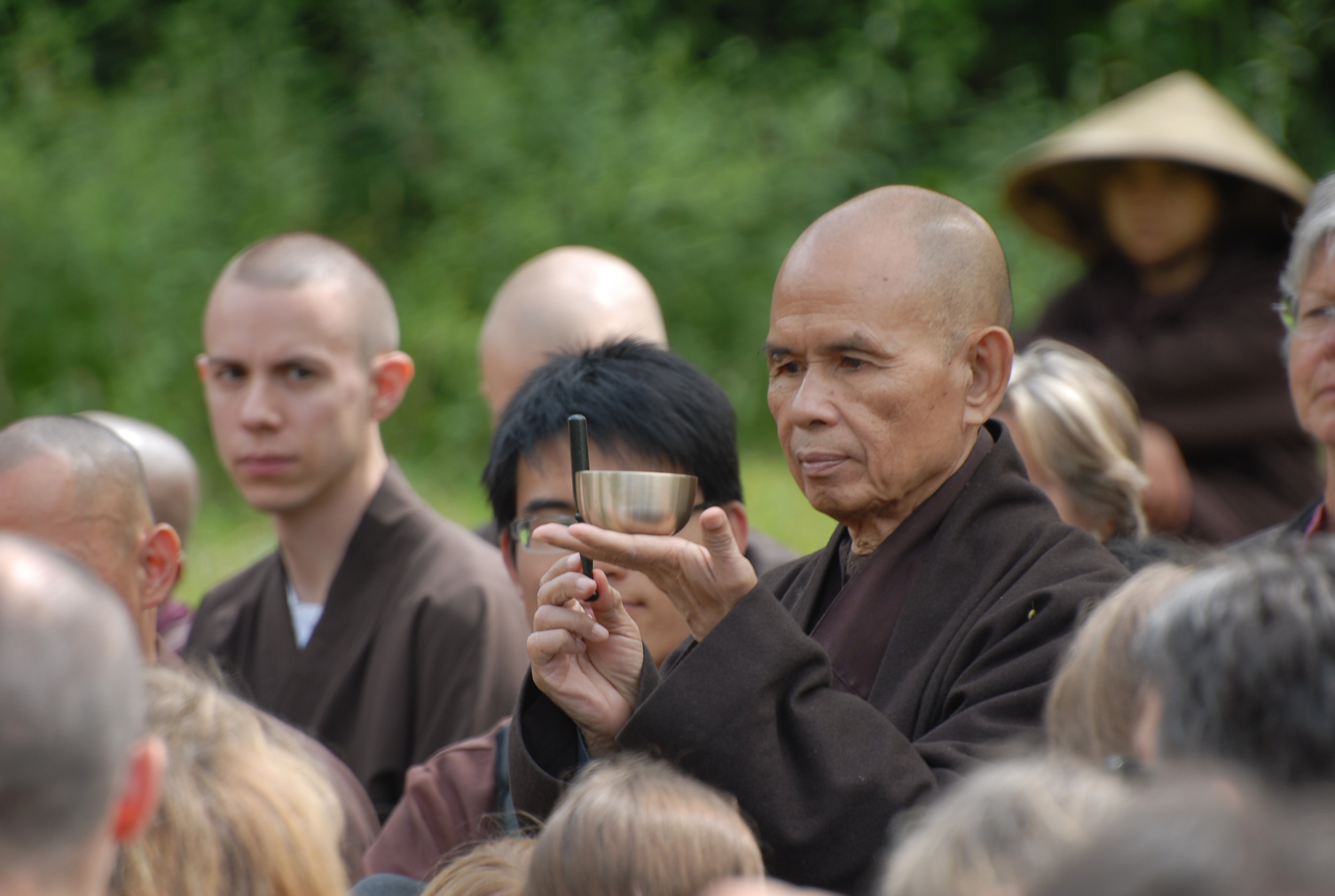
Thich Nhat Hahn and sangha
I am also a long time member of a Buddhist meditation group. Our weekly practice includes a session of mindful listening and speaking from the heart. We use a talking stick. Whoever holds the stick speaks and the others listen. We are a mixed group in terms of lifestyle and temperament but even so, through sharing, we learn that we are not alone having unique experiences. We also learn that in many cases, behind the brave faces, there is a pent up load of existential angst and anomie. It is better for this to be out than in!

I live alone and am retired. I have no wife or children. I spend a lot of time reading, writing and meditating. It is easy to be still and quiet. As a reality check I am also involved with various community groups in the fishing village in the NE of Scotland where I grew up and to which I have now returned. I mention these biographical details because they influence what goes on in my mind and thus the content of this story.

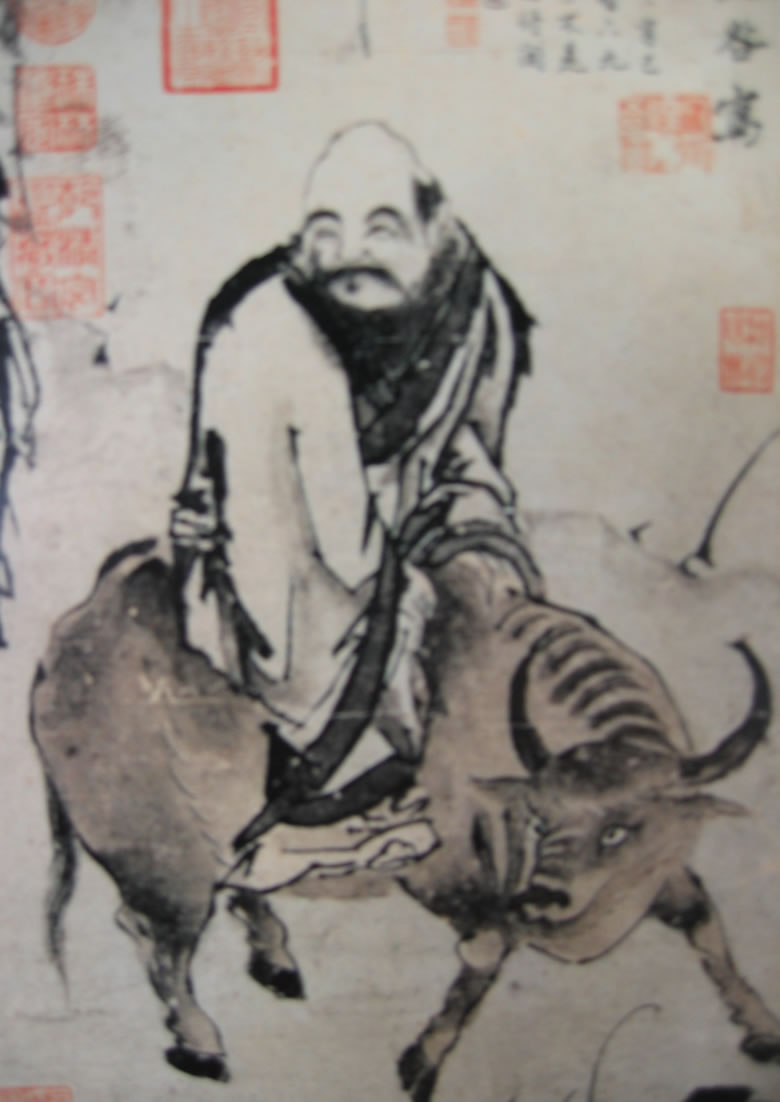
Lao Tzu leaving
My studies are mainly about the Dharma – the truth and teachings of the Buddha. But these days I seek to integrate the old teaching with the new sciences of evolutionary biology, evolutionary psychology, and of neuroscience. And there is another twist. I now seek not only objective and academic understanding but also subjective and heart-felt experience. The latter offers writing challenges given that, as Lao Tzu noted, “the reality which can be described is not the real reality” and that “those who know do not speak”.

For most of my working life I could concentrate and remain focussed for several hours at a time. I operated in flow and kept very busy. This was useful and productive at the worldly level but it meant that I rarely had time to stand and stare. During the slack times mental proliferation ran riot and I escaped the linked dis-ease through the distractions of wine, women and song. The notion of the illusory self ran wild and self indulgent.

In the more senior years – the last 20 or so – there has been more regular sitting. This is at times infested with mental proliferation and at other times by sloth and torpor. But increasingly the sitting slips into the mode of “no-self and outwith space and time”. This is very peaceful and seems correct and as it should be. There is an awareness of the Oneness which is everything. But, as noted above, words cannot do it justice.

There has also been an increase in everyday Zen and in 24/7 mindfulness. There is awareness of what is going on in the mind and thus a release from habits and from unthinking reactions. Shopping and cooking, washing the dishes, answering the phone, and squeezing out healthy defecations are suffused with a spiritual glow. There has been a paradigm shift in perception. The world is more numinous.

Several years ago I took a course in creative writing. I did not make as much use of it as I might have. Why invent stories when I can report on the never ending outpouring of papancha? Why indeed?

I now see that there was a problem figuring what to do with the inchoate churn that was generated as the mind ticked over and invented hazy and ephemeral patterns energised by hypothetical intentional agents. There was a never ending torrent of linguistic and emotional diarrhoea passing through the attention centre in insubstantial and short lived thought trains. The mind had a mind of its own. And its purpose seemed to be to scan the environment for potential rewards or punishments and to prepare the mind and body for appropriate action.

I have stumbled upon two ways of writing about this. They include elements of journaling and of blogging. Both are founded on the notion that Papancha flows from the unconscious and some of it reaches consciousness. There is a pre-planned method and an emergent method.

Pre-planned

The conscious bits of Papancha are noticed, labelled and mind mapped. This results in a structured skeleton upon which to hang the details of a story. The pre-planned principle is “think first and then write”. Rationality and consciousness are in charge – or at least they think they are.

Emergent

The emergent principle is to “just write”.  Intuition and the unconscious are fundamental sources of ideas but it is not quite right to say they are in charge. The idea is to “be in the mood” and to leave it to the “muse”.  Ideally perfectly edited, original text would be generated by the unconscious. But, in my experience, there are usually several rough edges that need sorting by rational consciousness.

>>>>>  <<<<<

This story emerged. It began yesterday and is now finishing. On rereading I see that it is in essence about the unspeakable dharma and about the psychology of perception. Words, sentences, paragraphs and pages are created and made available on the internet where they might prove useful to other dharma seekers.

Mental proliferation (Papancha) will not go away in a hurry. It is a source of much suffering but it need not be. It can be harnessed for generating many dharma stories. By taking thought we can know it for what it is and thus neutralise its unwholesome effects.

Could beditation be the answer to exam nerves? | Education | The Guardian

Could beditation be the answer to exam nerves? | Education | The Guardian

Flat backed mindfulness flourishes in schools

Monday, 4 March 2013

responsible for our intentions

Kornfield
In his book “A Path with Heart” Jack Kornfield deals with the concept of Karma. In brief, he notes that it is the intention behind thoughts, speech and actions that gives rise to good or bad consequences. The karmic concern is not so much ‘what is done’ as ‘why is it done’.

Thoughts arise about the nature and source of intention. I can imagine an interacting group of brain modules being the source of ‘agency’ for my intentions.  The modules are fed from two sources (a) sensory inputs (sights, sounds etc) in the present and (b) memories of earlier thoughts and feelings and their causes and consequences. Some of the outputs from the modules will feature in consciousness and some will inhabit the unconscious.

There is ongoing churn amongst the brain modules and this creates many items of thought and feeling as possible outputs. These are prioritised and form patterns which tell a story - and the intention to think, speak or act arises in consciousness. In most cases the conscious part is the tip of an unconscious iceberg.

Human babies and children are ferocious learners (their interacting brain modules are on overdrive). They quickly learn their culturally acceptable patterns of thinking, speaking and doing. The details that define a given person are due partly to nature (hard wired instincts), nurture (programmable learning), and serendipity (good or bad luck(chance)).

BUT – human beings are different from other animals and plants.  We are not only conscious, we can also be conscious of our consciousness –we can be meta-conscious. We can notice what we are noticing and think about what and how we are thinking. We are therefore capable of managing and controlling (a) our intentions and environments, and thus (b) the direction of our evolution as individuals and as citizens of planet earth.

This is an enormously empowering thought – and a bit scary in its implications. We will consider it again after some more thought about karma.

Do predators have karma? Cheetahs are conscious but it is unlikely that they are meta conscious. They have evolved to be as they are. In body and mind they are predators and they play their part in particular ecosystems and biogeochemical cycles. They are highly evolved killing machines. They act as they do without speaking or introspective thinking. They are magnificent robots. The intention behind their actions is not personal, it is hard wired. No intention, no Karma.

Does the cosmos have karma? It is difficult to imagine consciousness before the big bang and for a long time after it. It is doubly difficult to imagine meta-consciousness until reasonably modern people evolved.

Evolution operates without a central planning committee. There is vital churn that generates random variations and natural selection ensures that the fittest survive. But there is impermanence in all created things. Easy come and easy go. Death is necessary to make way for adaptation. Today’s fitness is tomorrow’s extinction.

People can be meta-conscious. The seat of this process is the hugely expanded neo-cortex in the human brain. It sets us apart from other animals. Amongst other things it contains modules that shape and control our use of language.

Human language ability is still evolving. It began about 50,000 to 100,000 years ago when people lived in small groups of hunters and gatherers. Endless hours of fun can be had trying to figure which words might have been the first to evolve. Our humanoid ancestors had lived for millions of years without language. They were then as speechless as the Cheetah. So which came first, the use of words or the expansion of the neo cortex? Probably in parallel.

The details remain hazy but it seems clear that language began as something quite primitive; but it was ‘fit’ in an evolutionary sense and gradually became more sophisticated and broadly functional. 

These days there is a hard wired language module in all human brains. It becomes active during early childhood. Nature ensures that a language will be learned while nurture decides which language it will be. A particular language shapes the human brain to match a cultural worldview. But different languages shape reality in different ways. Depending on your point of view this can result in cognitive entrapment, existential despair or universal liberation. 

The major world religions have their roots in ancient history. These were times of rapid social change. Creative thinkers used language to redefine what it meant to be human. Meta-cognition flourished. There was thinking about thinking. There was an increase in meta-consciousness but this tended to be limited to a few ‘mystical’ and heroic individuals and elites. 

Amongst  ordinary people the selfish, individualising and greedy ‘I’ illusion was evolving. It must have had its uses because it has survived and flourished over the last 3000 years; and it is now the driving force behind global consumer capitalism with its associated environmental ruination and bad karma. 

But the days of purely self-ish people may now be numbered. It is increasingly recognised that individuals are inevitably held to account for the intentions which drive their thought, speech and actions. If happiness is the goal then wholesome intentions are the means of reaching it. Religions, at their best, provide the means to liberate individuals from their self centred and unwholesome intentions. Mindfulness based meditation is a key tool in seeing through the illusion of self. This leads to knowing peaceful compassion and cultivating good karma. 

The last century saw a vigorous exchange of mystical and spiritual viewpoints between eastern and western cultures. This has resulted in 

  1. a wider and deeper understanding and appreciation of meta-consciousness in general,
  2. a flourishing revival of existential issues and of approaches to dealing with them, and 
  3. an encouraging increase in multi-disciplinary and multi-stakeholder processes when dealing with global policy and plans.


Let us now return to the empowering and scary notion of meta-consciousness, linked to language and to intention. Evolution has no forward plan. The cosmos has no intention.  There is therefore nothing eternal or absolute to fight for or against. We the people have the freedom to think, speak and act intentionally. By taking thought and thought about thought we can rid ourselves of the illusion of self and consciously shape our own evolution and that of the planet. 

The ultimate challenge is to be responsible for our intentions – who among us has what it takes to be part of the vanguard?

Thursday, 28 February 2013

dropped out

Why have I dropped out of society and employment? There are two main possibilities:

I am powering towards enlightenment through creating a simple life. Activities are strategically limited to (a) reading and writing about the dharma, (b) meditating, and (c) making ideas available to the world via the internet

… OR …

I am a burned-out case running back to my home base with my tail between my legs[i]. Activities are minimal as there is no energy or appetite for transforming education systems; not even for transforming individual schools. (My main paid employment was as an education advisor.)

The existential purpose-in-life issue is raised. To what extent am I more than a neurotic nihilist living in an existential vacuum? What does it mean to exist and what is the purpose in life? We could draw an academic concept-map to chart the recognised options but I presently have no appetite for it. There may, however, be an appetite for writing about it subjectively.

existence

My present viewpoint is that there is no reason to exist. There is no grand designer with a master plan. We are not ascending arrows in the biological synthesis. We are the vital churn of stardust whose beginnings and endings are unknown and perhaps ultimately unknowable. We can, however, be conscious of our consciousness but that won’t save us when the sun goes out.

As individuals we are social animals that can think and speak according to the patterns of our culture. But this tends to create parochialism and xenophobia. It involves mainly blind acceptance of our culture’s values and world view. This is intellectual laziness and an existential cop out.

Marks and Spencer's Supermarket
Given the potential of the human brain, cultural compliance constitutes (a) a lazy turning away from reality and (b) the ab-use of your brain and mind. In most cases the human brain is like a sports car that is never shifted out of first gear.

We use language to reify commodities. We succumb to hierarchy and become hooked on status symbols. Different sub cultures have their preferred supermarkets and, within a given supermarket chain, there are value brand (aka cheap) versions of products in eye-catching colours. Well-to-do shoppers would rather die than have value items in their trolleys.

And so it is for cars and clothes; houses and gardens; jewellery and cell phones; newspapers and TV programmes etc – capitalist consumerism.

What will people think? 
Who cares and why? 
Turn your mind around – be still and know that self is an illusion – rise above culture 

[i] I have developed Parkinson’s Disease which is a contributing factor