Thursday, 11 June 2015

Doodles from nowhere

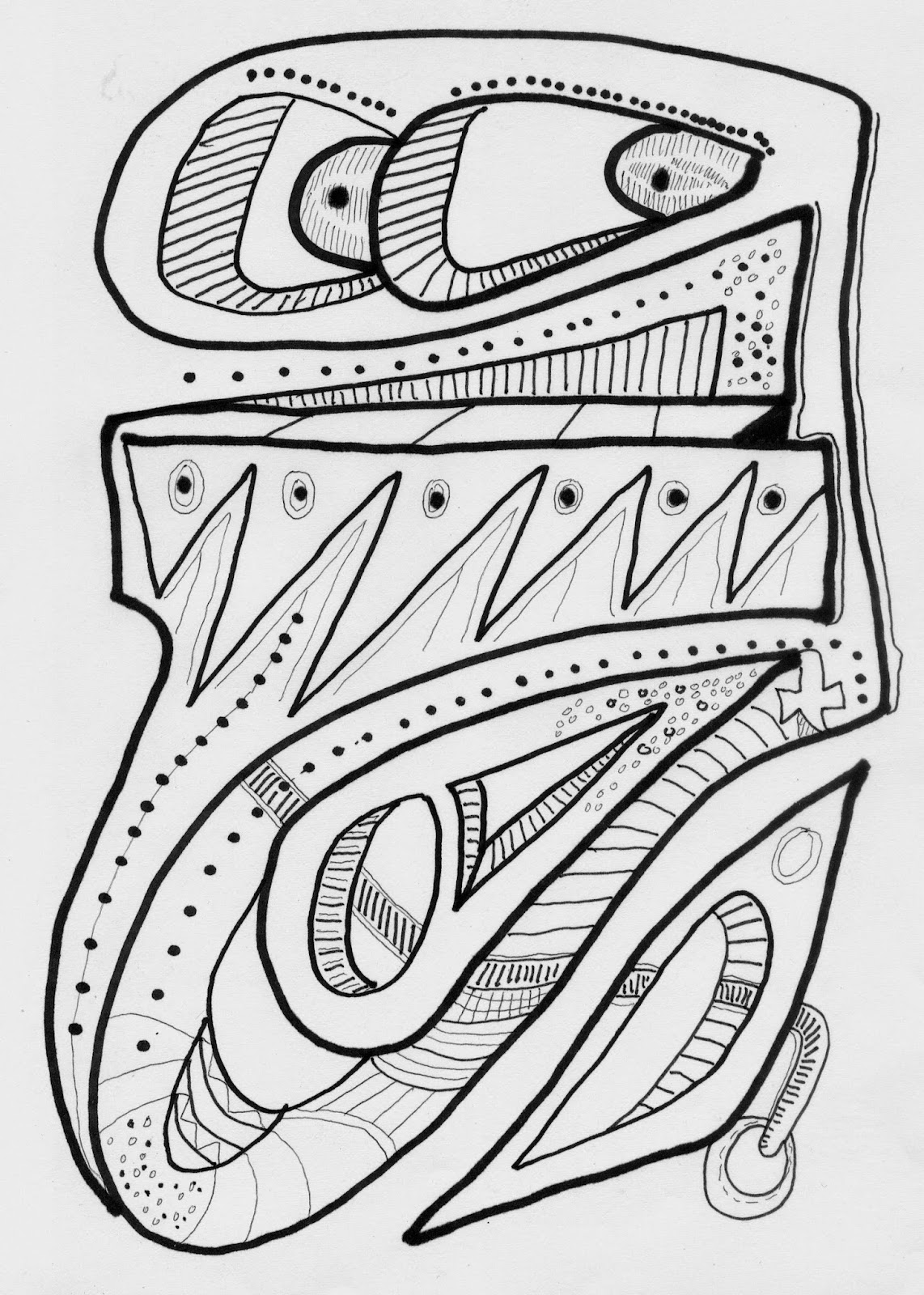
Doodling is a process that has a product. The physical tools are paper, pens and drawing board. The psychological tools include (a) the ability to use the pen and drawing board, (b) the mood and intention to do so, and, for the best quality work, (c) the ability to shut down the self conscious and thus to enter a non-egoic frame of mind where the unconscious is in charge.

While doodling there is very little forward planning. ‘I’ just sit until the hands move and marks are made on the page. This is what the Chinese call wu-wei or effortless action. At the moment this happens several times a day.

Each doodle has its own page and I note the date of its construction in the bottom right hand corner. Every now and then I scan the new collection and keep the files on a hard disc where they can be tagged and sorted. A while back I created a set of categories: abstract, scenes, and faces (single, groups, abstract). This needs a revisit.

I feel the agentic problem. There is product therefore there must be a producer who is presumably rational and purposive. But the presumption may be wrong – at least in part. In most cases the purpose and meaning of the doodle is not apparent.

Michael Shermer suggests that the human mindbrain is hard wired for patternicity and agenticity.  “Patternicity,” is the tendency to find meaningful patterns in meaningless noise. “Agenticity”: is the tendency to believe that the world is controlled by invisible intentional agents. Together patternicity and agenticity form the cognitive basis of shamanism, paganism, animism, polytheism, monotheism, and all modes of Old and New Age spiritualisms.

There is the notion that the unconscious is in a constant state of churn.  Mentation lego.  Gobbits of thoughts, feelings and moods (TFM) being shaken together in a sack. Some are fresh from the sense organs others are from memories of childhood through to what you had for breakfast this morning. A few are grabbed at what seems like random, made into a story by the unconscious, and dropped  into the attention centre  to see what the self-conscious can do with it.

The product is not the ‘truth’. Evolution is not concerned with such a thing. Pragmatism rules. If the story is convincing and ensures the survival of me and my group then we can accept it.

Through the years ‘I’ have engaged with several variations on this theme of giving the unconscious free rein

  • Art work in school – got a Higher
  • Doodles - ongoing
  • Many poems in the late teens and early 20s
  • Songs (music and lyrics) in two phases – 70s and 90s
  • Journal entries – since the late  60s
  • Short essays (one-pagers)
  • 75 tunes in the 90s
  • Brande flows (writing against the clock)
  • The seven word game (see below)
  • The seven word game is simple but awesome.  Try it for yourself and see.


SO - process and product:

  • The ongoing churn creates units of TFM (aka as ‘facts’)
  • The units are arranged to form a pattern (eg a World View or a group of points of view)
  • The pattern is championed by a real or  imaginary, intentional agent
  • The product is in essence a mind-made point of view but can be substantiated as spoken or written text, as music, or as doodles

SO - some thing from no thing?

  • Well over 100 doodles have been produced in the last few months
  • When I review them there is no strong message although there is a feeling that there should be
  • The abstract ones tantalise because of the details and the ambiguous perspective
  • The faces mesmerise even when they are basic emoticons – hard wiring in a social animal
  • At least one external viewer finds them scary
  • They do not encourage chat – they are pre-linguistic – like cave paintings?
  • The mood to produce  them remains frequent and strong
A physical doodle is created. It’s ‘cause’ is ‘activities’ in the mindbrain. The activities include the ongoing churn being fed by sensory inputs and by memories. Patternicity and agenticity are added to the mix. The purpose of the process is monitoring of the external environment to note whether the ‘thing’ is good, bad or indifferent. Relevant reactions and responses result. The fittest survive.

BUT there is a lot of noise in the system of churning. ‘Meaning’ need not always be created. Thus it seems we have doodles from nowhere.

Friday, 5 June 2015

Inviting writing to nurture culture

My blog has had 20,000 page views since January 2013. This averages 690 per month and 23 per day. The averages include low page views in the early stages. Last month for example there were 1240 page views which averaged 41 per day. It is interesting to know that my blog is being visited - but that is not what keeps me going.

I aspire to produce a blogpost every other day. The subject matter is mainly my reactions and responses to ideas about the structure and functions of the human mindbrain. This is a hot topic and there is an ongoing blending of eastern meditation with western neurology and evolutionary psychology.

However, on the downside, I am not officially connected to an institution and I do not have a large number of people to talk with and experiment on; and neither do I have a group of experts to provide peer reviews. But, on the upside, I have internet access to texts, audio and video from the leading experts in the relevant fields, and I have privileged, if subjective, access to my own mindbrain.

My mindbrain is shaped by nature, nurture and serendipity and most of its operations are confined to the unconscious. This becomes obvious when, during mindfulness, people feel that the mind has a mind of its own. Blaise Pascal (1623-1662) reckoned that “The heart has its reasons of which reason knows nothing”. The insight can be restated as, “the unconscious has its intentions of which the self conscious knows nothing”.

Sigmund Freud (1856-1939), while sitting in his armchair, reckoned that the unconscious was full of crude animal passions (notably sexual ones) that have to be held in check in civilised societies. However, recent research suggests a more positive view. It is the same nature, nurture and serendipity that shapes the unconscious and the self conscious parts of the mindbrain. So there is no need to demonise the unconscious; both parts have time-tested hard wiring designed to aid survival in small groups of stone age foragers in the African savannah. Some of this genetic programming might be out of sync with ‘modern’ patterns of living but cultural nurturing exists to shape them for the irrepressibly emergent new age.

Like most other people, especially western intellectuals after the European Enlightenment, I was earlier led to believe that the rational and egoic self-conscious should be promoted and the emotional and non-egoic unconscious should be suppressed. But, following research findings, there has been a dramatic turn around. I now view the mindbrain as a massive unconscious iceberg with a tiny, misty fragment of self-consciousness peaking above the vast ocean of reality.

Most of the important stuff happens in the unconscious. Many professional people now realise this and have learned how to exploit it. The trick is to shut down the self-conscious egoic chatter so as not to interfere. Athletes are in the zone, musicians are in the groove, and ordinary mortals operate in flow when they wash the dishes with numinous grace rather than with a grudge.

I am in two minds about my present method of being. I read, write and doodle non-egoicaly with a minimum of forward planning. This goes against my formal training - but that is the point. There is product in the form of stories and doodles that are generated effortlessly and in flow. It is as if something comes from nothing - but nothing comes from nothing. Thoughts, feelings and moods (TFM) originate in past times and are tweaked in the present by way of channelling the future. The evolving thought train never stops – not since the Big Bang.

There is need to radically change attitudes concerning ‘truth’ and ‘reality’ ie to change mindbrains. A thought train, which is in fact a TFM train, never in fact stops although many people, once they are culturally indoctrinated, are willing to die to maintain the status quo. We are all born free to be culturally nurtured but we are now at a stage of planetary evolution where more and more people are becoming mindful to the extent of appreciating that ‘reality’ is a mental construct which can be deconstructed.

Authors construct and deconstruct reality using spoken and written language. They come in assorted guises, notably, academics, bloggers, diarists, essayists, journalists, lyricists, novelists, playwrights, poets, scientists, speechwriters, and etc? I consider myself to be an essayist and blogger and I write for myself, for friends and colleagues, and for sub groups of the general public in various countries; there is a strong following in Ukraine and Russia.

There is a linguistic conundrum with the idea that ‘I’ write for my ‘self’. The idea is to park the ego and give my unconscious a free rein. There is an ongoing churn in the unconscious and every now and then a tit bit is directed to the conscious attention centre.

And that seems a good place to conclude with the title to this article - Inviting writing to nurture culture.

Monday, 1 June 2015

The need to know

The need to know – getting my existential jollies

A friend emailed to say that he will not be able to attend a pre-arranged meeting. No problem, I can reschedule my day. I don’t need to know what caused his change of plan.

I wrote the following sentence to send to the BT help desk - “When I am on the BT home page and click the email button the system goes to the login URL but then takes me back to the BT home page without logging in to the email.” But a reboot sorted the problem before I sent the email. I don’t need to know what went wrong.

I don’t need to know lots of things. I don’t bother with the nitty gritties. I get my jollies by wrapping my brain around counter intuitions and uncommon sense.

I suspect that there are different parts of the brain specialised in handling higher and lower degrees of conceptualising - possibly those parts of the pre-frontal cortex that deal with executive functions.

Most people do not philosophise about the grander aspects of their world view. They have been encultured to accept their natal version. They therefore inhabit a predictable, cultural universe which is chock a block with eternal verities:

  • The earth is flat.
  • Heavier than air machines cannot fly.
  • Atoms are indivisible.
  • A woman’s place is in the home.
  • We share ancestors with the great apes.
  • The Pope is infallible.
  • Kings and prime minister’s rule by divine right.
  • God is dead.
  • The war to end all wars.
  • Freemarket fundamentalism is the best guide to growing the economy.

My particular nature and nurture has been constantly reworking my world view with its list of verities. I was born into the UK class system as a subservient upper working class, church going, small town lad. But social mobility kicked in through being a boy soprano from seven, participating in archaeology digs from 14 and, studying for a university degree in Zoology from 18. I was a romantic in a tweed jacket who was convinced that the world could be a better place and that there must be better ways to be human. I committed to zero population growth and to experiencing different cultures. The need to know was at its peak.

By my early 20s my world view was informed by three aphorisms:

  • The only constant thing is change.
  • The only certainty is doubt.
  • So – follow the flow.

The western take on the aphorisms drew me to phenomenology, post-modernism and a vision of neurotic nihilists living in existential vacuums. All very depressing.

The eastern take on the aphorisms drew me to Taoism, Buddhism and Zen and to a vision of peaceful meditators living and working in non-egoic mindfulness. All very hopeful – at least in theory.

In the last twenty years or so there has been a blending of eastern and western world views and a rethink on the psychology of perception. The common root is an acknowledgement that thoughts, feelings and moods (TFM) are mind made mainly in the unconscious, and have no abiding reality – there is neural plasticity. The mind can change the shape and functioning of the brain which can change the mind. I feel the need to know more about this.

Evolution has been fine tuning the structure and functions of mindbrains since they first appeared due to cephalisation in ancient invertebrates. Bits of the ancestral mindbrains are still working in the lower regions of modern people including you and me. There are enduring structures and functions that first appeared in reptiles, mammals, primates, great apes and hominids. There are also new bits in human beings – notably the cortex and especially the pre-frontal cortex.

Since our stone age days of foraging these changes have allowed consciousness to be conscious of itself. And this ability has grown exponentially since language evolved, and it has enabled the growth of the eastern monastic tradition, western science and technology, and the hierarchical division of labour. I feel the need to know more about this.

Neurologists have been studying meditators. Their brains are different from ordinary folk. This is a result of thinking this way rather than that. They sit quietly and practice mindfulness. Amongst other things they bear witness to their monkey mind and, in so doing, calm it. Amongst other things the calmness allows a realisation of the ephemeral nature of their cultural points of view and this enables them to be un-attached from ‘truth’ and ‘reality’ and thus to radiate good humoured peace and encourage reconciliation. I feel the need to know more about this.

But who is the ‘I’ that ‘needs’ to ‘know’? And why those needs? And what does it mean to know? And which part of ‘me’ is asking those questions? One of my songs from the 70s has these lines:

“You’ll find plenty question masters
making quagmires of their brain –
The man said, “There is no answer”.
They said, “you are insane.”


I spent many years wallowing in the intellectual, truth-seeking quagmire. But mindfulness arose and with it the pre-linguistic realisation that “the reality which can be described is not the real reality”.  It was therefore arguably permissible, healthy and desirable to be open to change and doubt, to enthuse about counterintuitive uncommon sense, and to get my jollies by ignoring the nitty gritties and by calmly following the high level flow.

Thursday, 28 May 2015

Revolutionary ripples from a retreat

The internet is vast. It is easy to get lost and to fail to find world-changing wisdom in the oceans of facts.

BUT:

  • Search engines can return useful links (Ref: Google)
  • There are many online encyclopaedias (Ref: Wikipedia with its neutral point of view)
  • Using social networks you can follow and be followed by like minded souls from all parts of the planet. (Ref: Facebook and Twitter)
  • Like minded souls may well have blogs and websites from which you can take a feed. (Ref: Blogger and Wordpress)
  • The system learns your preferences and points you to interesting places. (Ref: ebay and Amazon)

SO …

It is relatively easy to focus on particular topics and to herd other people’s cows ie to analyse, systematise and memorise the conventional wisdom of the dominant group (COWDUNG).

It is also relatively easy to compare and contrast the ‘permissible’, alternative points of view that delimit and legitimise the hegemonic borders of what the Establishment considers to be ‘acceptable’ discourse.

It is also relatively easy to log in to the thoughts and feelings of the free thinkers who form the revolutionary vanguard. Often working in think tanks, these freelance philosophers exert countervailing and elegant power by liberating and deconstructing ideas that suffer elite capture.

Emancipated wage slave
When I was still a wage slave my duty and task was to rewrite thick, jargon laden, documents in plain language. So I was mainly reworking established wisdoms. My own thoughts and feelings were parked out of sight and rarely entered the attention centre.

Now I am retired and free to populate attention with whatever thoughts, feelings and moods (TFM) happen to emerge from the unconscious. I note a tendency to go back to Zoology which I studied from 1967 to 1971. My dissertation was in neurology and my extended essay was in primate social behaviour – small world.

My main areas of interest these days are intellectually in neurology, evolutionary psychology, big history, and mindfulness meditation, and, technically, in the art/craft of writing/blogging.

Linked TFM include:
  • Not being an accredited psychotherapist my first hand observations are limited to my own mindbrain
  • There are several subjective versions of ‘ego’ (I, me, mine, myself) (there is also William the witness – see earlier posts.)
  • Most of what the mindbrain does is confined to the unconscious
  • My main task is to become more aware of and awake to what goes on in the unconscious. This is done by paying attention to, and capturing what appears in, the attention centre. The ‘products’ are presently doodles and various forms of text.
  • ‘I’ am hard wired in the same way as everybody else but my enculturation is idiosyncratic as it includes many years working and living in various parts of the tropics. So in some ways what is ‘true’ about me is true of all humans, and in some ways my ‘I’ is unique.
  • ‘Present moment, wonderful moment.’ There is dis-ease (anxiety, stress, depression low self esteem and ‘what will people think?’) when I am mindful of the past or of the future. There is easy peace when non-egoic and in flow.
  • While being mindful of the present (eg by watching the breath) the switch can be flipped from dis-ease to easy peace.
  • The present moment these days typically lasts for only seconds although there can be switching. This is now the third day of writing this story. There has been a series of moments of thinking and typing which total about two or three hours. So how long did it take to write the story – three days or three hours?
  • The train of thought never stops for long on the never ending highway. Knowing this makes it possible to be unattached to a world view. Who lays the tracks?
  • The virtual Sangha is online with video, audio and text.
  • The analogue Sangha has about 30 regular members who meet once a week forty miles away. I have also attended several weekend retreats
  • My blog is a drip feed of pebbles in a pond where ripples run away – hopefully

There are many good thinkers and writers on all of my favourite themes. I am presently interacting with http://www.mindful.org/ whose board of advisors includes Jon Kabat-Zinn and Ritchie Davidson. And I am reading Watt, Tessa (2012-01-05). Introducing Mindfulness: A Practical Guide Icon Books. Kindle Edition.

Both sources are in plain language and are based on the experiences of large numbers of people. It is excellent stuff. I cannot compete as a textbook writer. I can, however, bear witness to what goes on in my head in terms of TFM. The target is a story every two days. The hope is that the stories might touch a raw nerve in some readers and that they are encouraged to continue their spiritual journey because of the revolutionary ripples from this idiosyncratic retreat.

Monday, 25 May 2015

Real moments

Reality changes one mindbrain at a time. But that mindbrain is influenced by others.

Changes in the environment lead to changes in the thinking, feeling and behavior of individuals, small groups, and even nation states. (Ref: demonization of Germans during WW2.)

‘Reality’ is changing its foundations from myth and magic to materialism and mindfulness: from pre-modern (traditional) to modern (scientific) to post-modern (consilient).

This train of thought is influenced by having just read the following sentences of Richard Restak:

“At this moment, while writing this sentence, I’m fully conscious of my purpose. Indeed, each of the sentences in this essay would be impossible if I didn’t remain conscious of my intention while writing them. Yet I’m not aware what precise form the sentences will take – that comes when I see them displayed on the screen. Thus my writing of this essay is a mix of the conscious and the unconscious.” [Restak, Richard M. (2012-10-25). The Big Questions: Mind (Kindle Locations 686-688). Quercus. Kindle Edition.]

It is the same for me but more so in that I am not fully conscious of my intention for writing this essay. There is a misty appreciation for the insights provided by scientists (Zoologists in particular eg J Z Young) about the evolution of brains in general, the embryological development of human brains, and the processes of enculturation in human groups. (Ref: ontogeny recapitulates phylogeny)

There are similarities between this spontaneous writing, and doodling. The unconscious streams and generates product - text and images respectively. ‘I’ am not aware of a forward plan for more than the next few seconds. Decisions about what appears next do not give the impression of being rationally controlled by the Executive functions in the pre-frontal cortex.

The main difference between the texts and the images is that the former have obvious meaning while the latter do not. I am assuming that both are rooted in the mindbrain churn where present sensations meet past memories and future actions are planned and sometimes implemented.

“If I have seen further it is because I stood on the shoulders of giants.” (Isaac Newton). I think in particular of those who summarised rational modes of action/reflection cycles eg

PIME
  • (Situation appraisal)  Planning
  • Implementation
  • Monitoring
  • Evaluation  (Situation appraisal)

Countervailing power
  • Gather information
  • Analyse information
  • Prioritize actions
  • Create an organisational mechanism
  • Periodically reflect on activities

Lesson planning
  • Aims
  • Objectives
  • Content and Method
  • Monitoring
  • Evaluation

In acquiring three university degrees I was encultured into believing that ‘I’ should ‘think’ objectively and generate evidence-based conclusions ie that I should use the scientific method. No problems. But, as I get older, ‘I’ ‘sense’ the potential of other ways of thinking and feeling.

There is the image of an iceberg with a vast amount of unconsciousness below the surface and a tiny bit of consciousness above it. ‘I’ am convinced (aka I believe) that there is much to be gained by focusing attention on attention. The belief has its roots in multidisciplinary science but it is informed by idiosyncratic subjectivity.

The serious stuff includes neurology, evolutionary psychology, Big History, and mindfulness meditation. The idiosyncratic stuff includes sitting, reading, writing and doodling. This results in alterations to my world view (Zeitgeist).

Reality changes one mindbrain at a time. (time = milliseconds to centuries)


Friday, 22 May 2015

perseverance


Two frogs fall into a bucket of milk and can’t jump out again. One gives up paddling and drowns; the second one refuses to do so and keeps paddling until the milk turns  into cream and it is able to get out.

Tuesday, 19 May 2015

My consilient Zeitgeist

The Zeitgeist Movement (TZM) has its critiques. I found them by Googling ‘tzm critique’ – duh!

TZM includes a lot of “wouldn’t it be nice if …” from a libertarian (anarchic) point of view. (Ref: https://www.youtube.com/watch?v=3SZT7MZop44)  But TZM assumes that economics is at the root of all things and thus underplays the psychosocial.

Having engaged with the topic there are now a lot of ideas swimming around in the attention centre. I will collect some
  • There is only the one thing which is everything (Note – the cosmic zoom puts things in perspective – we are star dust)
  • The one thing is the mega system which is made up of subsystems which are made up of subsystems. (Ref: systems theory)
  • Nothing stands alone, everything is connected (Note: Thich Nhat Hahn has the concept of Interbeing which links to deep ecology.)
  • Scientists operate using the best working hypotheses presently available. (Note: there is a tendency for older scientists to get stuck in outdated hypotheses. Science progresses one funeral at a time.)
  • Science is a product generated by a process. The product is (a) a theory based on evidence and (b) the theory being applied. The process is in part technical (eg controlled experiments etc) and in part psychosocial (the scientist operates in a cultural context with deep rooted values).
  • Modern ways of thinking are evolving away from the myths and magic that guided past ideas. They had their uses in times past but times have changed.
  • The only constant thing is change. The only certainty is doubt.
  • The thoughts about consilience (ref Sociobiology) from E O Wilson and from David Sloan Wilson are in the same ballpark
  • “In science and history, consilience (also convergence of evidence or concordance of evidence) refers to the principle that evidence from independent, unrelated sources can "converge" to strong conclusions. That is, when multiple sources of evidence are in agreement, the conclusion can be very strong even when none of the individual sources of evidence are very strong on their own. Most established scientific knowledge is supported by a convergence of evidence: if not, the evidence is comparatively weak, and there will not likely be a strong scientific consensus.” http://en.wikipedia.org/wiki/Consilience

Sunday, 17 May 2015

Obscurity or celebrity

Amazon has an uncanny way of creating lists of books that might interest me. But, there are 100 items on the list of Kindle ebooks. That is too many. Overload. So, I scroll through them and note the artwork on the cover, the author (known or unknown), the customer rating, and the price. If something catches my attention I look more closely.

Amongst today’s recommendations is Team, Tzm (2014) “The Zeitgeist Movement Defined: Realizing a New Train of Thought”. Kindle Edition. This caught my attention because of the word (Zeitgeist) and the price (99p). So the next task was a quick flick through the blurb on the jacket cover and then on the tops and tails of the text. I liked their idea of a new ‘train of thought’. The train never stops. ‘Truth’ has a cultural context. Globalised humanity is potentially a radically new cultural context.

But they might be lunatic fringe. What does Wikipedia say about them from its neutral point of view? Information is buried here – http://en.wikipedia.org/wiki/Zeitgeist_%28film_series%29#The_Zeitgeist_Movement

“Zeitgeist: The Movie (2007) started the chain of events leading to the introduction of the Zeitgeist movement. The group advocates transition from the global money-based economic system to a post-scarcity economy or resource-based economy. VC Reporter's Shane Cohn summarizes the message of the films and the movement's charter as: "Our greatest social problems are the direct results of our economic system". The films criticize market capitalism and the price system method in general.

TZM’s is a ‘leaderless movement’ with no central funding although small scale fundraising may be needed to cover expenses at the local level. For example, Peter Joseph, the founder of The Movement, is the sole financier of the Global Chapter website, its Administration, along with the core Zeitgeist Movement "Main" events, such as Zeitgeist Day, Zeitgeist Media Festival, etc).

Peter Joseph


“Joseph created a political movement that, according to The Daily Telegraph, dismisses historic religious concepts as misleading and embraces a version of sustainable ecological concepts and scientific administration of society. The group describes the current socioeconomic system as structurally corrupt and inefficient in the use of resources.”

“Zeitgeist: The Movie is a documentary-style film with two sequels: Zeitgeist: Addendum and Zeitgeist: Moving Forward, presenting a number of conspiracy theory ideas. Peter Joseph created all three films. The Zeitgeist Movement is a trademark of Gentle Machine Productions which is owned by Joseph.”

Peter Joseph (1979 – on going ) film maker (http://en.wikipedia.org/wiki/Peter_Joseph ) would appear to be a controversial outrider. He has given several TED talks. (http://peterjoseph.info/biography/) and has been written about in many high profile newspapers and magazines. But he does not get mentioned by the cutting edge authors that I read. This might be because he is not part of the academy

SO – is TZM destined for obscurity or celebrity? Time will tell. Thanks to Amazon for pointing.

Friday, 15 May 2015

Moulding the workforce

Every school day morning the students gather at the bus stop across the road from my present house. Half a century ago I used to be at that same bus stop at the same time.

The bus gathers the uniformed youth and transports them from the Council estate to the institutionalised school where the bell rings the changes every 40 minutes: for five days a week and most of the 52 weeks in a given year for more than ten years.

This thought train led to a flow of ideas about how and why I, and just about everybody else, gets moulded to suit the workplace.

Universal primary and secondary education. What’s it all about?

  • It keeps the kids off the streets till they are old enough to join the workforce.
  • It introduces them to a set of knowledge, skills and attitudes (KSA) appropriate to the worlds of work in our modern nation and in the new global world. In theory critical thinking and life long learning are developed – but not too much!
  • It homogenises kids so that they know their place and respect their elders and betters.
  • It examines and grades them to make it easier for employers to recruit them.

You can therefore view the education system as a vast and expensive way of moulding the citizens such that they are able and willing to slot into the many worlds of work.

The many worlds of work. What’s it all about?

  • Self sufficiency: I live in an old cottage with a walled garden big enough to feed a family. I could in theory grow all my own food, harvest rainwater, and build a composting toilet. It is more difficult to deal with electricity, clothing, and heat in the winter. The theory is not easy to put into practice. The Technological and Industrial Studies Group (TISG) in the south Sudan gave up its space programme because none of us knew what iron ore looked like. Instead we tried to build a wooden bicycle.
  • Work, rest and play: people of the First World spend eight hours sleeping, eight hours working and eight hours resting and playing. On a daily basis this involves, amongst other things, being distracted by the media and by social networks – increasingly online. Many people also set aside one or two weeks to go somewhere else and do something else, often as a package that includes exposure to ‘have a nice day’ smiles from service providers who are paid a pittance compared with the customers.
  • The undeserving poor and welfare benefit scroungers present austerity targets for right wing politicians.  I appreciate the stereotype but I do not know of living examples in my own community – maybe I don’t get out enough! I suspect that the total welfare payments are tiny relative to the total of unpaid taxes – by an order of magnitude. (Ref)
  • Extremely long finger nails were a status symbol when I was teaching in Zambia. They were indicators of indolence, especially for boys who were obviously in a position to avoid manual grafting. I have no way of knowing whether they were better suited to less physical forms of work.
  • Buy and sell stuff: I use money to buy many things mainly through the internet. The money comes from having sold my labour at a good price before I retired. Thus I have savings, investments and pensions. So I am now independently wealthy and no longer a wage slave and compelled to work.
  • With grace or grudge: what matters is not so much the kind of work that you do as your attitude towards it. Who is better off, the person who cleans public toilets for a pittance but with grace v the person who designs community sculptures for a fortune but with a grudge?

Three official definitions

Three Types of Work (Bellah et al. 1996) introduced the following famous division of the three kinds of work – job, career, and calling.

  • A job's function is to provide means to satisfy basic needs.
  • A career's function is self-expression and mastery.
  • A calling puts one's talents in the service of something greater.


The Good Work principles delineated by Howard Gardner, Mihaly Csikszentmihalyi and William Damon (Gardner et al. 2001) are: engagement, excellence, and ethics.

  • Engagement means that the worker can feel a sense of connectedness and presence with her work.
  • Excellence means that she can produce high quality results competently.
  • Ethics means that she will also carry the responsibility of the short and long term effects of her work to others
   
https://ajattelunammattilainen.files.wordpress.com/2013/10/the-three-keys-to-meaningful-work-final.pdf

Decent work, according to the International Labour Organization (ILO), involves opportunities for work that is productive and delivers:

  • a fair income,
  • security in the workplace and social protection for families,
  • better prospects for personal development and social integration,
  • freedom for people to express their concerns, organize and participate in the decisions that affect their lives, and
  • equality of opportunity and treatment for all women and men.

Some other ideas:

Slavery, wage slavery, sweatshops, zero hours contracts, production lines, trade unions.


SO – the school children put in a lot of time being moulded and groomed for the world of work. Is the formal school system still a good way of managing the task?

Monday, 11 May 2015

Being non-egoic

[Ian the interviewer and William the witness chat about the joys of being non-egoic.]

Ian: “You said earlier that the goal/reward is being non-egoic and that this involves being in the present moment. Would you like to expand on that?

William: Thanks for asking. There are at least three ideas. The first is ‘being non-egoic’. This is captured in the Zen saying, ‘no-self, no problem’. When athletes are in the zone and musicians are in the groove there is an altered state of consciousness. It is captured in Csikszentmihalyi’s concept of ‘flow’. There is also the concept of ‘everyday Zen’ and the potentially mystical experience that can be achieved while washing the dishes or cleaning the toilet.

Ian: This presumably links to what you earlier noted as doing things with grace rather than with a grudge.

William: Exactly. What matters is not the activity itself but rather the state of consciousness you are in while engaged with it.

Ian: The secret is ‘being in the present moment’.

William: Spot on. Most people most of the time suffer from ‘monkey mind’ which involves ‘attention’ veering off into knowledge, feelings and moods (KFM) about ‘me’ in the past or future. Concentration loses track, time is wasted, and the overall mood tends to being unsettled, unsatisfactory and uneasy.

Ian: That is where being in the ‘present moment’ comes in.

William: Quite so. The mindbrain can be tuned into the past via the memory circuits, and into the future via the speculation and planning circuits. Part of the tuning in involves using language and thus evoking the ‘I’ illusion with its negativity bias. Our mindbrains evolved to monitor the social and physical environment and to react and respond to change. And where there are choice points the pessimistic perspective has the greater survival value.

Ian: On the other hand, if an athlete’s mindbrain dithers in the past or future, she will not perform as well as if her mindbrain is with the non-egoic present moment.

William: There is another Zen saying, ‘present moment, wonderful moment’. It happens when you ‘drop off body and mind’ and ‘just sit’. For whatever reason, the human mindbrain is capable of an untroubled, peaceful numinosity. While it is happening there is no ‘I’ to register what is going on but, in retrospect, there are many subjective reports of ‘transcendence’, enlightenment, and great peace.

Ian: Your third idea is presumably ‘goal/reward’.

William: There is a catch 22 when an ego sets the goal of being non-egoic. I want to see through the illusion of I and thus be a non-toxic member of my community. If, for the sake of having a starting point, ‘you’ aspire ‘as if’ the ego was real there can be a suspension of belief until the understanding of reality deepens. Language is a poor tool for dealing with these kinds of thing!

Ian: Lao Tzu reckoned that ‘the reality that can be described is not the real reality’

William: Yes but the reward can deliver itself when washing the dishes. Everyday Zen can be intuited on a level beyond words. There is no need for the intellect and its words - they normally get in the way.

Sunday, 10 May 2015

Churn and the changing mind.

Ian: “That sounds like William.”

William: “Yup, it is/is not ‘I’”

Ian: “What insights have come to your calm attention lately?”

William: “Flow has been switching on and off between grace and grudge. It is too easy to let attention be captured by the social media during elections. But it can be cut or rationed. Rationing is the middle way. But there needs to be a quality control mechanism so that I focus on good stuff. ”

Ian: “How is ‘good’ to be understood in this case?”

William: “My monkey mind has been active in the attention centre these last few days. The focus has been politics and the election. There has been a load of churn: and I sense a positive feeling for change. A new political door has been opened to peaceful protest. This is good.”

Ian: “So, where next?”

William: “I do not yet have a well thought through map of political economy. There are many buzzwords and sound bites but their meanings are often multiple – and they depend on the politics of those who use them. This can seriously undermine the quality of discussion and debate in the privacy of your own head or in the wider market for ideas.”

Ian: “So, what is to be done?”

William: “I have been on holiday from the heavy existential stuff and engaging with the election process. This mainly involves cruising the social networks and alternative news sites.”

Ian: “Now that the elections are over will you get back to the more serious stuff?”

William: “Hopefully, but I note today that Cameron and the Tories are back in No 10, and already there are street protests about the austerity policy.”

Ian: “Yoh – politics have changed – more people are more heavily involved.”

William: And that makes it more difficult to live in retreat and calmly be aware of churn and the changing mind.” … “Having got this story off my chest and out of my mind there can be a return to just sitting.” … “What about yourself?”

Ian: “I do not exist. I am just a literary device.”

Thursday, 7 May 2015

Progressive politics

Progress is about change for the better. But who decides what is better? Those on the right of the political spectrum have different views from those on the left. Some of those seeking election at the moment suggest that there is need for anti-austerity progressive politics. In what follows I gather some thoughts on this hot topic.

Think for example of welfare. This involves a city, state, or national government providing financial or other assistance to an individual or family. In a welfare state the government (the state) plays a major part in protecting and promoting the economic and social well-being of its citizens, and in ensuring that they can realise their potential. It is also a safety net to prevent vulnerable people from slipping in to poverty. It is based on the principles of:

  • equality of opportunity,
  • equitable distribution of wealth, and
  • public responsibility for those people who cannot provide themselves with the minimal requirements for a good life.

Those on the political left see the enlargement of welfare as a sign of progress. Those on the political right see it as regress – and vice-versa.

Those on the right reckon that government welfare encourages lazy, work-shy scroungers who need to get on their bikes and find work so they can pay taxes and buy stuff. When a large government becomes a nanny state it takes the hard earned wealth of the rich and the super-rich individuals and corporations, and uses it to subsidise shirkers.

Left wing parties are said to be based on ‘tax and spend’ or ‘Robin Hood’ policies. This involves taking from the rich and giving to the poor and this requires a large and sometimes inefficient public service.

Right wing policies are needed because nature is red in tooth and claw. Rational entrepreneurs are thus required to stand on their own two feet; and the cream of the crop will rise to the top. The only functions of government are to manage the police force and the armed forces to contain domestic and foreign unrest and ensure the rule of law. There is no need for the government to manage the economy as the invisible hand of the free market will sort things out.

Right wingers thus encourage privatization, and savage cuts to welfare spending, because they belief that the private sector is more efficient and cost effective than the public sector which is feather bedded and shielded from market forces. A brief look at the results of privatization shows that things are not that simple. Government actions are to provide services and to plough profits back into the organisation. The private sector exists to make a profit to be distributed amongst shareholders. The history of the private sector taking on government contracts is not a pretty one.

Note – the state provides corporations with a healthy and well educated work force; with infrastructure (eg roads, railways and airports); utilities (eg water, sewerage, waste disposal); security and the rule of law – the list goes on and includes various subsidies and bail outs. This suggests that the extreme right wing position is mythical.

SO … there are two ways of defining progressive politics and both can have many details. I have listed a few of them in the following table. You can add more items depending on your personal points of view.


Monday, 4 May 2015

Why Austerity?

I was confused by all the chat surrounding the elections. So many points of view. So many meanings for words. So much playing at ‘politics’. I decided to gather my thoughts about politics, economics and austerity. The results, still far from satisfactory, follow.

Most cultures have a small group of people, an elite, that commandeers most of the available wealth and power. The elitists reckon this is OK “Because I am worth it” and because “It is God’s will - and so by Divine Right.” And anyway, in terms of fairness, some of the wealth will ‘trickle down’ from the rich to the poor, and a rising tide floats all boats. This line of thinking leads to massive exploitation of people (eg slavery and sweat shops) and of the environment (eg greenhouse gases and waste disposal). The elitists form the ‘Establishment’.

Most cultures have a large group of people, the masses (aka the proletariat or plebs), who aspire to a more equal distribution of wealth and power. This usually involves using the government to manage the process.

There are four main political persuasions depending on the desired size of government and on the distribution of wealth and power (see box):


The present UK elite connives to hold on to and accumulate more wealth and power, and to keep government small. This is the politics of the right with labels such as Neo-liberals and freemarket fundamentalists. Amongst other things they lobby for:

  • lower taxes,
  • fewer regulations,
  • a smaller state, cut back the welfare nanny, and
  • weaker trade unions and tame media

The present UK politics of the left (the Labour party) can be labelled as neo-liberal lite. To act as a more effective opposition they need to recreate themselves as democratic socialists. This seeks a more equitable distribution of wealth and power through taxing and spending in a welfare state. Key manifesto points include:

  • Progressive taxation to pay for the welfare state
  • Appropriate regulations eg health and safety at work; environmental stewardship
  • A welfare state to provide eg Education, NHS, infrastructure, housing, pensions, national defence
  • Trade unions - Minimum wage, free press

It appears that, previous to Mrs Thatcher, common sense was on the side of social democracy and neo-liberalism was on the lunatic fringe. Thatcherism with its spin doctors reversed Establishment thinking and promoted the view that greed is good. This line of thinking continued with new labour and then with Cameron’s tories.

Past governments have accumulated debt which has to be paid back using income from tax. But that income is also needed to pay for the welfare state. There is not enough income to pay for both. There are two solutions – (1) increase taxation and (2) cut welfare spending. This calls for austere (harsh) policies involving cuts to welfare - some people are going to suffer – guess which?

Austerity disadvantages the masses and offers many advantages to the elite. Some of the policy options are set out in the following table:


The austerity theory has lost all credibility and is back on the lunatic fringe everywhere except in the UK. (Ref Krugman). It is OK to borrow to support the welfare state. The increased productivity that results can pay back the debts.

…oooOooo…

I found the following two articles in the Guardian to be insightful:

Owen Jones (2015) A cruel society is being built. Voting Labour begins the fightback http://www.theguardian.com/commentisfree/2015/apr/21/cruel-society-vote-labour-rights-tory

Paul Krugman (2015) The austerity delusion. The case for cuts was a lie. Why does Britain still believe it?
 http://www.theguardian.com/business/ng-interactive/2015/apr/29/the-austerity-delusion

And the following book titillated my left leaning tendencies - Owen Jones (2014-09-04). The Establishment: And how they get away with it. Penguin Books Ltd. Kindle Edition.

…oooOooo…

  • My initial enculturation puts me left of centre where I know my subservient and dutiful place eg as cannon fodder in two world wars and as a frequenter of food banks.
  • In my early days I reckoned with Schumacher that ‘small is beautiful’ and I enjoyed the thoughts of anarchists.
  • These days I tend towards subsidiarity and letting a thousand flowers blossom, while recognising the limitations of the ‘good and great’ who are not my ‘elders and betters’.
  • What passes for ‘reality’ in myself and others is just a figment of our imaginations.
  • Participatory democracy demands understanding multi-stakeholder processes (MSP)
  • Those who engage with mindfulness meditation can be non-attached to their world view and to their host of subsidiary points of view. Such people can be a calming influence in political debate on local through to international platforms.

A couple of my early lyrics come to mind:

“There’s a voice inside you – it’s the voice of other men
It’s the voice of people dead and gone
Whose preaching makes the world go on – or off”

“You’ll find plenty question masters making quagmires of their brain
“The man said, ‘there is no answer’,
They said, ‘you are insane.’”

Saturday, 25 April 2015

Head Voices

Ian the young interviewer and William the elderly witness personify interactions in the human mindbrain. Oliver the omniscient introduces himself.  

Ian: “Am I a feature of your imagination?”

William: “Yes but then so am I.”

Ian: “So why do you bother to imagine us?”

William: “You - Ian - came into being a few days ago as a literary device. Rather than state my topics in an essay ‘I’ can make ‘my’ points through answering your questions. As William the witness I have been present on and off for several years. The cast of characters that make up the illusion of self or ego could possibly be expanded.”

Ian: “Can you give an example.”

William:  “An obvious one is Ulric the unconscious who never sleeps. He continuously churns inputs from the sense organs together with thoughts, feelings and moods (TFM) that are stored in memory. This leads to the creation of stories. Most of them are inconsequential but every now and again they will point to things which are rated urgent and important. (Eg a lion looking for lunch) These are passed to the executive functions in the pre-frontal cortex where particular, personal policies, programmes and projects are prepared.”

Ian: “Aha – that’s cute. Ulric the unconscious is a non-egoic, workaholic, maintenance engineer. Who else?”

William: “There is Victor the vital force that gets me out of bed in the morning with my heart pumping blood and passing it through the lungs where carbon dioxide is removed and oxygen is added. Victor also prompts me to find and digest food, to extract the ‘goodness’ and pass out the leftovers as pee and poop. Victor is also in control of many other life processes such as, irritability, locomotion and reproduction. The reproduction process includes transforming a fertilised egg into a baby in nine months. Victor does not say much. He is part of the old, ancestral mindbrain and predates language by a long way.”

Ian: “So we could say that Ulric the unconscious is an upmarket version of Victor and he integrates the modern, human mindbrain with the ancient parts. Victor is the engine and Ulric is the engineer.”

William: “that is cute. Next in the chain is Stanley the story teller who rose to prominence in the days following the evolution of language. He is capable of fast reaction or more considered response to the thoughts, feelings and moods that seep out of Ulric’s churn. Stanley does most of his work in the unconscious but when conditions are appropriate he can commandeer the attention centre in whole or in part.”

Ian: “So there is a chain – Victor the engine, Ulric the engineer, Stanley the PR man.”

William: “Yup – that works. When Stanley commandeers the whole of the attention centre he calls up Zorba the zombie who is blown around like a dry leaf on a windy day. Zorba does not pay attention to what is going on and is infested with monkey mind and the notion that the mind has a mind of its own.”

Ian: “OK - we can add to the chain - Victor the engine, Ulric the engineer, Stanley the PR man then Zorba the dim customer.”

William: “Right – and the story so far is the one that most animals and people use. This is possibly what it is like to have basic animal consciousness.”

Ian: “So – to summarise - non-stop Victor and Ulric churn data so as to have something to monitor in the environment. Stanley then creates stories which guide Zorba’s reactions and responses.”

William: “and the stories cover the idea of there being an abiding self, ego or I. Zorba the zombie runs on autopilot and illusion - but it would appear to be a winning formula – at least thus far – the human population is still expanding.”

Ian: “That feels disappointing. I seem to want to believe that there is some greater purpose.”

William: “No problems - there can be much more. Alfred is awake and aware. He notices and thinks about TFM. He is a learning machine. He is capable of sophisticated insights that go beyond the elemental reflexes and instincts. Sometimes he experiences numinosity and sometimes flow.”

Ian:”Aha – we enter the area of mind training through meditation where there are two tasks – stilling and seeing.”

William: “Yup I am William the witness. I am the cool dude who watches what happens with Zorba and Alfred as they slip across the attention centre. So long as I remember to drop off body and mind ‘I’ operate peacefully and non judgementally and recognise mind stuff for what it is – ie not ‘real’.”

Ian: “You presumably spend a lot of time just sitting and dropping off body and mind.

William: Yup – I am attracted to Zen Buddhism and to Dogen Zenji from 13th century Japan.

Ian: “But calm abiding is not enough. There is need for action, for engaged Buddhism.”

William: “Oliver the omniscient appears after Alfred and William. He knows that TFM is just mind stuff and he has a flexible, liberal Weltanschaung  which is open to ‘meaningful’ TFM. He is rooted in science but transcends academic, western philosophy.”

Oliver: “Hi chaps! I thought to introduce myself. At the mega level I reckon that we are dealing with a psychology of perception. Most of us muddy our waters and lose focus and clarity. If we are to achieve clarity we must sit still and let the mud settle. There are now many developments of Jon Kabat-Zinn’s MBSR course. ‘Mindfulness’ is often characterised as Buddhism lite. I have not yet made up my mind (which part?) but there is still energy to keep trying. Do you two feel the energy?”

William and Ian: Yup

Alfred: me too and I can feel bodily stirrings which I interpret as Victor, Ulric, Stanley and Zorba being up for it as well. Coordinated voices – Yoh. If you sit still you will know them.

Monday, 20 April 2015

A writing dialogue

Is it time for a new compilation? What is now different about the thoughts, feelings and moods (TFM) that float up from the unconscious? Am I whirling on a repetitive circle or am I slowly elevating on a progressive spiral?

A conversation follows between different aspects of my ‘self’ – the inner witness (William) and a neutral interviewer (Ian).

William admits that, “I have been reading kindle books about how to write”. This piques Ian’s curiosity and raises the question “Have you learned anything new and exciting? “Yes” was the reply, “but not as much as I might have.”

“Why not?”

“Because attention wanders and I dose a lot.”

“Sloth and Torpor – one of the Buddhist hindrances - what do you do about it?”

William pauses to gather his thoughts. “The main thing is that I don’t worry about it. My sleep pattern is disturbed by Parkinsons and its medication. So I go with that flow. There are few urgent calls on my time so dosing is rarely a problem.”

Ian is intrigued. “How do you arrange things such that you do not worry about it?”

William smiles. “The one word answer – ‘mindfulness’. The two word answer non-egoic mindfulness. Remember to be the witness and thus take the sting out of the monkey mind’s thoughts, feelings and moods (TFM). They then pass away and are no longer a threat to ‘calm abiding’.

Ian: “What happens when you forget to be the mindful witness?”

William: “Ego returns and brings discomforts through putting attention in the past or future.”

Ian: “Does that happen often?”

William: “Not as much as it used to. Practice has paid off. Several days can pass without existential ennui.”

Ian: “What do you do when the ennui appears?

William: “Just sit. Notice it, label it and let it go. Sometimes I put attention somewhere else. Wash the dishes; mow the grass; make a doodle; read a book; listen to a dharma talk – or a TED talk; write a story.”

Ian: “Ah yes – writing. What have you learned from your recent studies?”

William pauses to gather TFM and to focus his reply: “The basic principle is ‘show don’t tell’. Even in non-fiction report writing. Anecdotes and dialogue capture and hold a reader’s attention.”

Ian: “What are your feelings about this piece of dialogue writing?”

William: “There seems to be motivation to read more about it and to develop my skills. The topic might merit a compilation.